Review · TOURS
Private Prague Renaissance & Baroque Gardens Walking Tour
Prague’s grandest garden stories unfold away from the usual castle interiors. This private walk links the Royal Garden, Queen Anne’s Summer Palace, Wallenstein Garden, and the small but stunning Vrtba Garden, with tales of tulips from a Turkish sultan, exotic fruit grown in Central Europe, and peacocks roaming beside Baroque statues.
I like the scholar guide format, which turns clipped hedges, fountains, and old stone walls into clues about royal ambition. I also like the private setup for up to 10 people, especially if you want to ask questions or adjust the pace. The main drawback is practical: several steep stairs lead to Vrtba Garden’s upper terrace, and admission to Vrtba and the gardens below Prague Castle costs extra.
Key points to know before you book
- Royal garden stories with unusual details: Learn how Ferdinand I developed the castle gardens, how gardeners raised exotic fruit, and how tulips reached Prague.
- Four very different garden stops: Compare Renaissance order, Italian-style design, palace courtyards, grottoes, fountains, and Baroque terraces.
- A private group of up to 10: You get a more personal walk and can ask questions without keeping pace with a large tour group.
- Vrtba Garden brings the best view: Climb to the top courtyard for a memorable look toward Prague Castle and the city.
- The tram ride is part of the plan: After meeting your guide, the group takes tram 22 to the castle gardens.
- Plan around the season: The gardens close during winter, from November through March.
Why Prague’s gardens are worth three hours
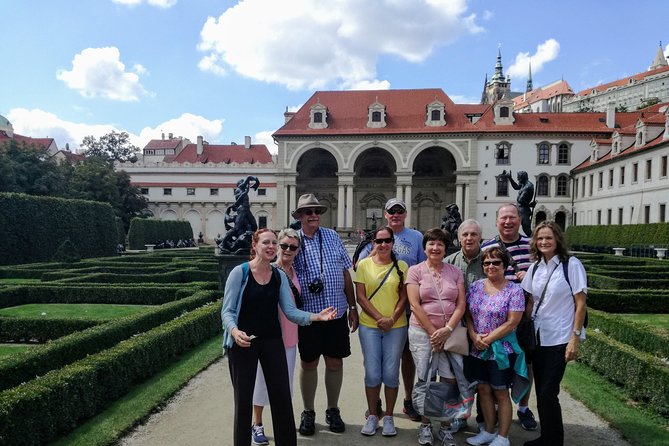
Many first-time visits to Prague focus on the Old Town Square, Charles Bridge, and Prague Castle’s major buildings. That plan makes sense, but it can leave out one of the city’s most enjoyable contrasts: formal gardens tucked behind walls, palaces, and castle slopes.
This tour gives you a way to read those spaces. You are not simply walking past a fountain or admiring a hedge. You hear why a Renaissance ruler wanted rare plants, how garden design changed during the Baroque period, and what a royal garden said about wealth and power.
The route covers several sites rather than lingering in one large park. That keeps the three hours varied, but it also means the pace is purposeful. You should be ready to walk between stops, stand while listening, and manage stairs. A moderate level of fitness is recommended.
The private format matters here. Garden details are often small: a figure on a frieze, a mythological statue, a grotto built to look natural, or a view carefully framed by terraces. With only your own group, you can ask about those details and spend a little more time where your interest takes you.
More Garden Tours in the world:
- Paris: Versailles Palace and Gardens Full Access Ticket
★ 4.6 · 41,579 reviews - Amsterdam: Keukenhof Entry & Shuttlebus with Flexible Return
★ 4.7 · 11,891 reviews - Versailles: Skip-the-Line Tour of Palace and Gardens Access
★ 4.7 · 10,429 reviews
Starting at Malá Strana and taking tram 22
The usual meeting point is in front of Bagel Lounge Malostranská at Letenská 118/1 in Malá Strana. If you arrange pickup and provide a central hotel or flat address, pickup is offered. Otherwise, meet the guide at the stated location.
The group then takes tram 22 together to reach the castle gardens. This is a useful part of the outing, not a nuisance. It saves you from beginning with a long uphill walk and places the castle area into the wider city transport network. The tour ends back at the meeting point according to the provided arrangements.
Morning and afternoon departures are available. I would choose based on your wider Prague plans and the season. Since the gardens close from November through March, check the operating period before you book. The tour is offered in English.
The Royal Garden and Queen Anne’s Summer Palace
The Royal Garden was created in the 1500s on land that had previously held medieval vineyards. Its first purpose was not simply to provide a pleasant walk. Renaissance courts used gardens to display control over nature, access to rare plants, and links with distant parts of the world.
Your guide explains how the garden became known for unusual botanical specimens and plants brought from far away. That story gives the clipped paths and formal design a wider meaning. The garden was a place of experiment and prestige as much as relaxation.
The scheduled visit here is about 15 minutes, so expect an introduction rather than a long, slow stroll. The short stop works well if you want a broad understanding of the garden before moving to its architectural highlights.
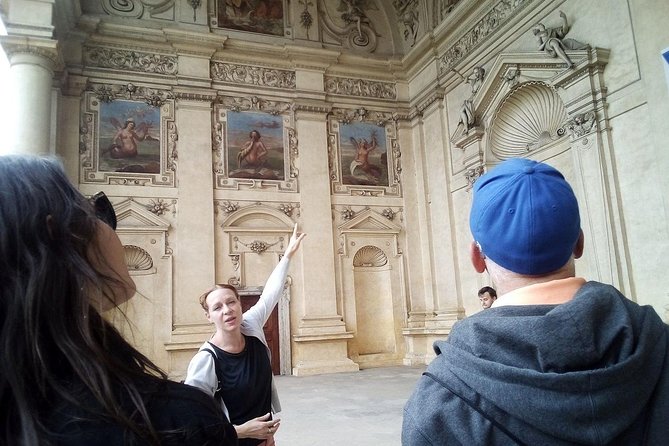
Queen Anne’s Summer Palace, also called the Belvedere, receives a shorter stop of about five minutes. The building is considered one of the purest examples of Renaissance architecture outside Italy. Its arcades have decorated Tuscan capitals, while the exterior frieze shows scenes of mythology, hunting, and war.
Look for the image of Ferdinand I wearing the Order of the Golden Fleece and offering his wife, Queen Anna, a fig tree blossom. The detail connects the building to the garden’s botanical theme. It is a small image, but it helps explain why plants and royal symbolism often appear together.
The palace was presented by Ferdinand I to his wife, and the surrounding grounds formed part of that royal gesture. You will not get an extended palace visit from the brief stop, so this portion suits you best if you enjoy architecture and historical context rather than interior touring.
The Fig House, Orangery, and Ball Game Hall
The garden story continues with the Fig House and Orangery. These spaces show the practical side of royal gardening. Gardeners worked to grow exotic fruit trees in a climate where they did not naturally thrive, helping introduce fruit cultivation on a new scale in Central Europe.
That is one of the most appealing details on the route because it moves beyond grand rulers and decorative design. You get a glimpse of the work behind a royal garden: skill, experimentation, careful protection from the weather, and the desire to bring distant plants into the court’s reach.
The Ball Game Hall sits on the south side of the Royal Garden, directly above the Stag Moat. Built in the middle of the 1500s, it first served as a hall for ball games and later became a riding school and stables.
Again, the stop is brief. Think of it as part of a connected story about how the castle grounds changed use over time. You will hear about the building and its setting, but this is not a long interior visit.
The tour also includes the story of the bronze-cast Singing Fountain. Its sound and design add a more sensory moment to the formal garden. Another memorable tale concerns a gift of tulips from the Turkish Sultan to the royal gardeners. That gift helped start a tulip craze, showing how gardens could spread fashion as well as plants.
Same corner of the map, a different planting:
- Marrakesh: Majorelle Garden Entry Tickets
★ 4.5 · 9,651 reviews - Vienna: Schönbrunn Palace & Gardens Skip-the-Line Tour
★ 4.7 · 7,739 reviews - Granada: Alhambra & Gardens Tour w/Nasrid Palaces Option
★ 4.2 · 7,022 reviews - From Paris: Versailles Palace & Gardens with Transportation
★ 4.6 · 6,222 reviews
Wallenstein Garden’s statues, grotto, and peacocks
Wallenstein Garden offers a sharp change in mood and design. Created in the 1600s for Wallenstein Palace, it uses an Italian-style layout and now serves as the gardens of the Senate of the Czech Republic.
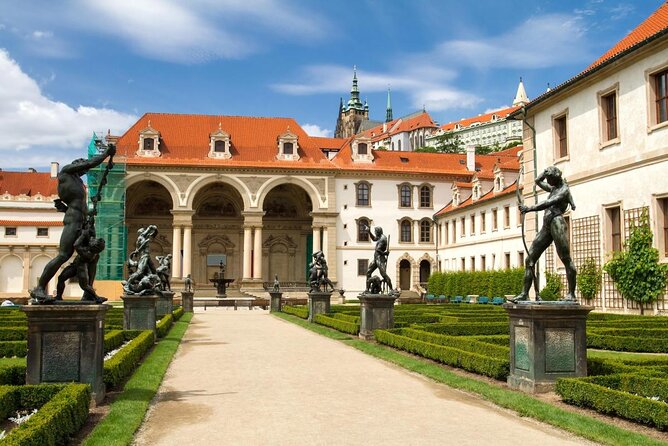
Admission here is free. You will see an aviary, an artificial grotto, fountains, and a sculptural gallery filled with mythological heroes. The garden’s theatrical style is classic Baroque: arranged views, grand gestures, and decoration meant to impress from several angles.
The statue work is tied to Adrian de Vries, whose fountain is one of the garden’s notable features. The grotto is especially useful for understanding the period’s taste for controlled fantasy. It suggests a natural cave, but it is carefully made and placed within a formal setting.
Albino peacocks add a touch of odd charm. They are not the reason to book the tour, but they are exactly the sort of detail that makes this stop memorable. You will also notice how the garden differs from the earlier Renaissance spaces. The design is more dramatic and theatrical, with stronger contrasts between architecture, sculpture, water, and planted areas.
The 25-minute visit is long enough to see the main elements and hear the story without turning into a full palace tour. If you want lots of time for photographs, you may need to move efficiently.
Prague Castle’s South Gardens and terraced gardens
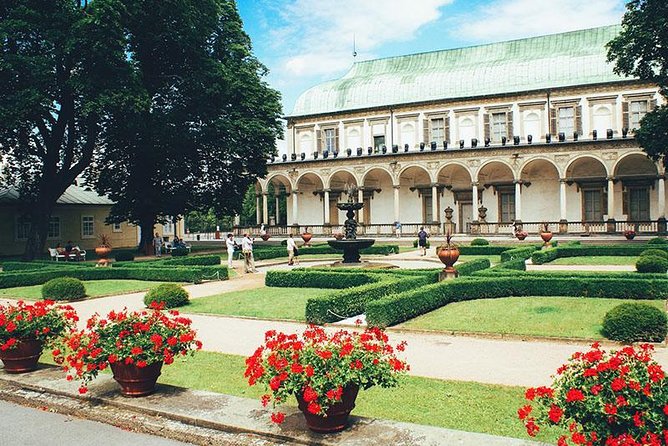
After the royal garden area, the walk continues through castle courtyards toward the South Gardens and Garden of Paradise. The route then reaches a series of terraced gardens set on the slope below the castle.
This section is valuable because it connects the castle’s formal power with Prague’s changing levels. Gardens below the castle are not flat city parks. Their terraces make use of the hillside and create changing views as you walk.
Admission for the gardens under Prague Castle is not included, so budget for that separately. The tour description does not give the exact combined admission amount, and prices can change. Ask at booking or before departure if you want to know the current fee.
The slopes also explain why comfortable shoes matter. You do not need special equipment, but this is not a flat promenade. Allow extra effort if you have trouble with hills or uneven walking.
Vrtba Garden and the view from the upper terrace
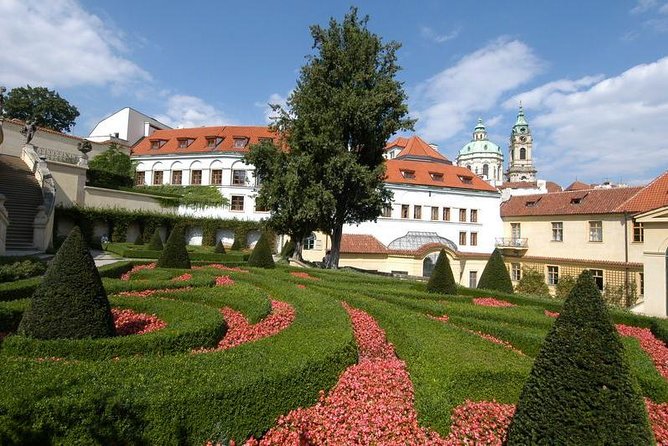
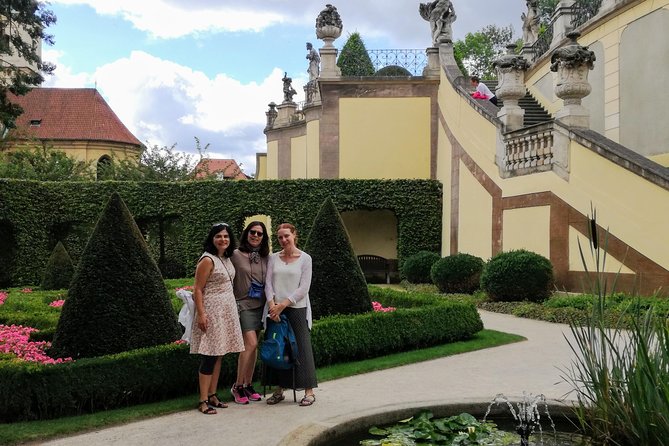
Vrtba Garden is the tour’s final major stop and one of its best surprises. It is a Baroque walled garden dating from 1720, with original statuary and sculptural decoration from the early 1700s.
The garden is compact, but its design uses the slope cleverly. Terraces rise toward an upper courtyard, where you get fine views across Prague and toward Prague Castle. This is the place to pause and look back at the city rather than simply inspect another formal planting scheme.
The climb includes steep stairs. If stairs are difficult for you, you can wait below, or arrange a private version tailored to your group. That flexibility is useful, but you should be clear about your needs before the tour begins.
Vrtba admission is not included in the tour price. Since this is a private experience, the extra ticket cost applies separately to your group. The garden is also seasonal, closing from November through March.
What makes Vrtba worth the extra effort is the combination of scale and viewpoint. Large royal gardens can impress through size, but Vrtba works through carefully stacked terraces, sculpture, and a final city view. It feels like a fitting end to a tour about garden design and social power.
What the $397.36 group price gets you
The listed price is $397.36 for a group of up to 10 people. That is a serious price for a three-hour walk if you are booking alone or as a couple. Split among a full group of 10, however, it works out to about $39.74 per person before admission fees, which makes the private format much easier to justify.
The value comes from the guide rather than transportation or included tickets. You are paying for a private English-language walk led by a scholar guide, with stories that connect plants, buildings, royal families, garden fashion, and architecture.
The price is strongest for families, friends, or small groups who would otherwise book several separate spots on a public tour. It is less compelling if you want a low-cost overview or prefer to explore gardens at your own speed.
Bonita is one guide named in the available feedback, and the praise centers on her detailed explanations and the parts of Prague that many people would miss on their own. That fits the design of this experience: the value lies in noticing details and hearing the stories attached to them.
Who will enjoy this garden walk most
I would choose this tour if you have already seen Prague’s main landmarks and want a different side of the city. It also suits anyone who likes architecture, botanical history, royal stories, sculpture, and views more than crowded interiors.
Families may appreciate the variety. The route has fountains, statues, peacocks, palace buildings, tram travel, and unusual stories about fruit and tulips. Still, the walk includes hills and stairs, so younger children may need help staying engaged during the guide’s explanations.
The private setting works well for photographers, garden lovers, and anyone with specific interests. You can ask about Renaissance design, Baroque decoration, royal symbolism, or the plants themselves without competing with a large group.
It is not the best match if you want a completely relaxed stroll with no uphill sections. It is also not ideal in winter, when the gardens are closed. Finally, remember that the tour focuses on gardens and their history. If your main aim is to tour Prague Castle interiors, choose a different experience.
Practical details that affect your day
Wear comfortable shoes and expect a moderate amount of walking. The Vrtba stairs are the clearest physical challenge, while the terraced gardens below the castle add slopes to the route.
Pickup is available from a central hotel or flat if you provide the address. Without that arrangement, meet in front of Bagel Lounge Malostranská. Confirmation arrives when you book, and the tour is near public transportation.
Admission to Vrtba Garden and the gardens under Prague Castle is extra. Wallenstein Garden is free, and the listed stops at the Royal Garden, Queen Anne’s Summer Palace, and Ball Game Hall do not require an additional admission fee as stated in the tour details.
You can cancel for a full refund up to 24 hours before the start time. Changes or cancellations made within 24 hours are not accepted for a refund. The cut-off follows Prague local time.
Should you book this Prague garden tour?
Book it if you want a private, story-led look at Prague’s gardens and are happy to pay for a scholar guide rather than a simple walk between sights. The mix of royal plants, tulip history, Renaissance buildings, Baroque sculpture, peacocks, and city views gives the three hours plenty of variety.
I would especially recommend it for a group of four to 10 people, when the cost becomes easier to share. If you are traveling alone or as a couple, compare the private price with other guided options before committing.
Skip it if your budget is tight, stairs are a serious problem, or you are visiting between November and March. For everyone else, this is a thoughtful way to see Prague beyond the postcard route, with Vrtba Garden and the royal gardening stories providing the strongest reasons to go.
FAQ
How long does the Prague garden tour last?
The tour lasts approximately three hours.
Where does the tour start?
The usual meeting point is in front of Bagel Lounge Malostranská at Letenská 118/1 in Malá Strana, Prague.
Is hotel pickup available?
Yes. Pickup is offered from a central hotel or flat if you provide the pickup address. Otherwise, meet at Bagel Lounge Malostranská.
Is transportation included during the tour?
After meeting the guide, the group takes tram 22 together to reach the castle gardens.
Is this a private tour?
Yes. Only your group participates, with a maximum group size of 10 people.
Are garden admission fees included?
No. Admission to Vrtba Garden and the gardens under Prague Castle is not included. Wallenstein Garden admission is free.
Are the gardens open in winter?
The gardens are closed during the winter season from November through March.
Is the tour suitable for someone who has trouble with stairs?
The tour includes steep stairs at Vrtba Garden to reach the upper terrace. You may wait below, or arrange a private tour that can be tailored to your group.
Just added around the world
- Yu Garden Shanghai Entry Tickets Booking And Trip★ 3.6 · 9 reviews
- Zanzibar: Jozani Monkeys, Butterfly Garden & Reptile Park★ 5.0 · 2 reviews
- York: Castle Howard Gardens and Grounds Entry Ticket★ 4.5 · 23 reviews
- York: Castle Howard House and Gardens – Self-Guided★ 4.8 · 120 reviews
- Royal Horticultural Society: Harlow Carr Garden Ticket★ 4.7 · 14 reviews
- Woking: Royal Horticultural Society Wisley Garden Ticket★ 4.7 · 24 reviews
- Woodside: Filoli Historic House and Garden Entry Ticket★ 4.9 · 9 reviews
- Xochimilco floating gardens, Coyoacan and UNAM murals★ 4.0 · 6 reviews
Tours, compared.

Skip-the-Line Tour of Palace and Gardens Access
Read our review →
Schönbrunn Palace & Gardens Skip-the-Line Tour
Read our review →
Alhambra & Gardens Tour w/Nasrid Palaces Option
Read our review →
Skip-the-Line Schönbrunn Palace & Gardens Tour
Read our review →
Cooking Class, Market & Thai Herbs Garden Tour
Read our review →
Versailles Palace Guided Tour & Gardens Access
Read our review →
Versailles Palace and Gardens Tour from Paris
Read our review →