Review · TOURS
Prague Renaissance & Baroque Gardens Walking Tour
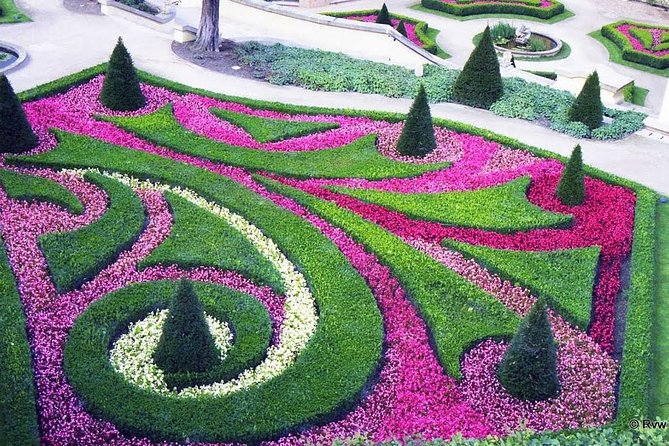
Prague’s best garden walk is less about flowers than the ideas hidden in the statues, fountains, and carefully planned views. In three hours, you’ll move from the Royal Garden at Prague Castle to Wallenstein Garden and Vrtbovská Garden, where a steep climb brings a fine look across the city.
I like the eight-person limit, which gives the guide room to answer questions and adjust the talk to your interests. I also like the way the tour links plants and design to politics, mythology, and royal ambition, rather than treating each garden as a pretty backdrop.
The main catch is cost and timing. At $126.03 per person, this is a specialized tour, not a cheap orientation walk. You may also need to pay garden admission separately, and Vrtbovská Garden includes steep stairs.
Key things to know before you book
- Royal plants with a surprising backstory: See the Fig House and Orangery, where figs, almonds, oranges, and lemons were grown in central Europe.
- A small group of up to eight: You get a more personal guide experience than on a large city tour.
- Three distinct garden styles: Compare Renaissance geometry at Prague Castle with the theatrical Baroque design of Wallenstein and Vrtbovská gardens.
- Mythology is part of the tour: Statues of ancient gods and heroes help explain how garden art once served political messages.
- Two departure choices: You can choose a 10am or 2pm start.
- Plan for extra admission fees: Vrtbovská Garden costs CZK 130 for adults, while the Prague Castle gardens cost CZK 90. Reduced rates are listed for students and seniors.
Why these gardens reveal a different Prague
Most first visits to Prague focus on the Castle, Charles Bridge, Old Town Square, and the grand churches. That route is worthwhile, but it can leave you seeing the city mainly as a collection of buildings.
This walk changes the pace. Gardens give you room to look at how nobles wanted the city to feel. A straight path, a statue placed at the end of an alley, or a fountain surrounded by mythological figures all had a purpose. Your guide connects those choices to the people who commissioned them and to the culture of Renaissance and Baroque Europe.
That is the real value here. You are not simply being shown three green spaces. You are being taught how to read them.
Bonita and Vadim are among the guides associated with this experience. Bonita is especially noted for storytelling, Greek and Roman mythology, and the way she explains Prague from both an art and history angle. The guide team also works well with locals who already know the city, so you do not need to be a first-time visitor to get something from the walk.
The tour lasts about three hours and is offered in English. Choose between 10am and 2pm. I would choose the morning if you want cooler conditions and a fuller afternoon afterward. The afternoon departure works well if you want a slower start to the day.
More Garden Tours in the world:
- Paris: Versailles Palace and Gardens Full Access Ticket
★ 4.6 · 41,579 reviews - Amsterdam: Keukenhof Entry & Shuttlebus with Flexible Return
★ 4.7 · 11,891 reviews - Versailles: Skip-the-Line Tour of Palace and Gardens Access
★ 4.7 · 10,429 reviews
Starting at Malostranská and riding tram 22
Meet at Bagel Lounge Malostranská on Letenská in Malá Strana, close to Malostranská Metro station. The group then rides tram 22 together toward Prague Castle.
The tram ride is useful, not just a way to save your feet. It gives the tour a clear beginning, taking you from the lower town toward the castle district before the garden walk starts. Since the activity is built around a small group, the guide can help keep everyone together during this short public transport connection.
You should arrive ready for a moderate amount of walking. The route includes garden paths, ordinary city movement, and steep stairs in Vrtbovská Garden. Comfortable shoes matter more here than stylish ones.
The published route details describe the gardens in slightly different orders. One outline places Vrtbovská Garden first, while the longer description presents it as the final stop. Since the guide may adjust the sequence, confirm the order when you meet. The important point is that all four major garden areas are part of the experience.
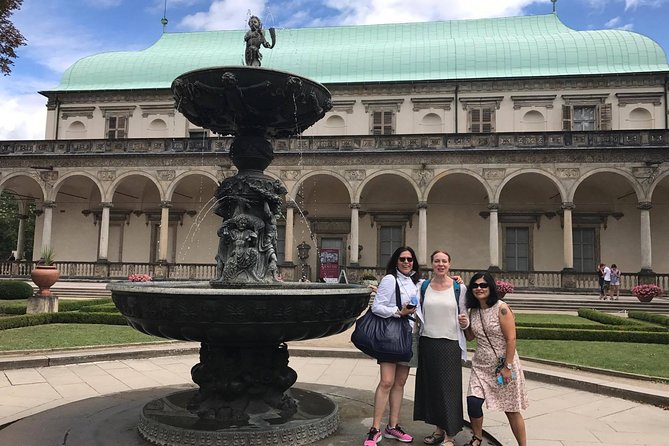
Royal Garden and Queen Anne’s Summer Palace
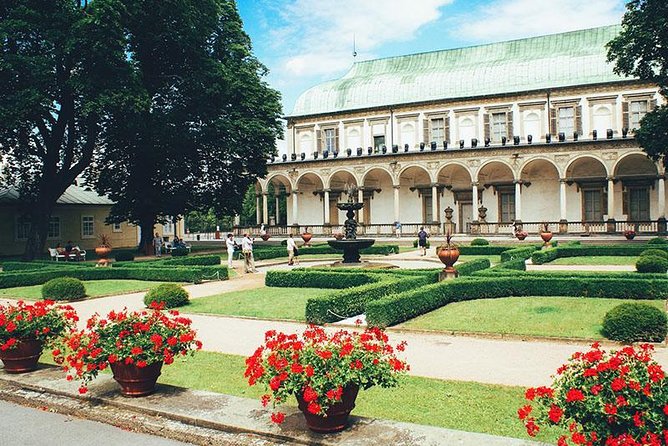
The Royal Garden at Prague Castle began on the site of medieval vineyards in the 1500s. It was designed as a Renaissance garden and became known for unusual plants brought from distant places.
This is where the tour’s plant stories become especially useful. The garden reflects a time when rare plants were signs of wealth, curiosity, and international connections. The Fig House and Orangery point to the effort required to grow figs, almonds, oranges, and lemons in central Europe.
You’ll also hear about the arrival of tulips in Prague. That detail helps turn what could be a simple garden stroll into a story about trade, status, and changing taste. If you enjoy botany, garden design, or old trade routes, this part will likely hold your attention.
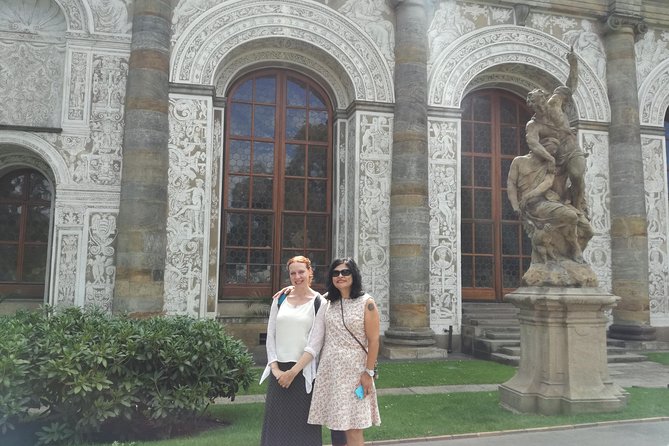
The garden’s architecture matters just as much as its planting. Queen Anne’s Summer Palace, also called the Belvedere, is a graceful Renaissance building completed in the middle of the 16th century. Its arcades, Tuscan-style column capitals, and decorative frieze show the period’s love of classical forms.
Look closely at the reliefs. They include scenes of mythology, hunting, and warfare, along with Ferdinand I and Queen Anna. One image shows Ferdinand offering his wife a fig blossom, a small detail that ties the palace back to the garden’s plant culture.
You only spend about five minutes at the Summer Palace as a formal itinerary stop, but the surrounding Royal Garden receives more walking time. That is a sensible balance. The experience is about the whole setting, not an extended architectural tour inside the palace.
The Ball Game Hall above the Stag Moat
The Ball Game Hall sits on the southern side of the Royal Garden, above the Stag Moat. Built in the mid-1500s, it first served as a place for ball games and later became a riding school and stables.
This is a short stop, listed at about five minutes, but it gives you another example of how royal spaces changed use over time. The building is part of the larger story of court life, where sport, display, animals, and ceremony all occupied the same estate.
Do not expect a long interior visit here. The value is in seeing how the building fits into the castle grounds and hearing how its function shifted. The guide keeps the focus on context rather than pretending every stop needs a lengthy presentation.
Same corner of the map, a different planting:
- Marrakesh: Majorelle Garden Entry Tickets
★ 4.5 · 9,651 reviews - Vienna: Schönbrunn Palace & Gardens Skip-the-Line Tour
★ 4.7 · 7,739 reviews - Granada: Alhambra & Gardens Tour w/Nasrid Palaces Option
★ 4.2 · 7,022 reviews - From Paris: Versailles Palace & Gardens with Transportation
★ 4.6 · 6,222 reviews
Wallenstein Garden and its theatrical Baroque design

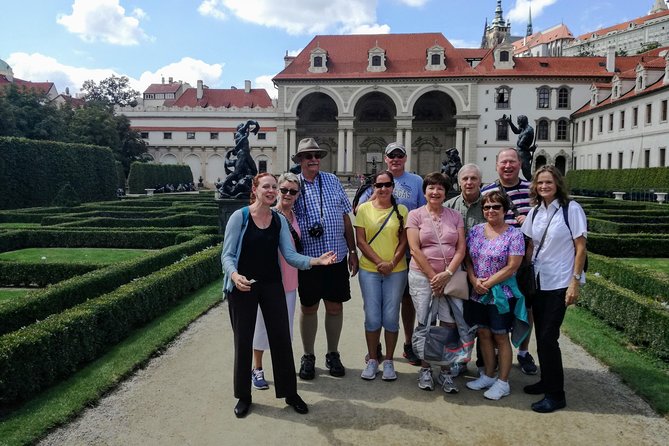
Wallenstein Garden offers a sharp contrast to the Royal Garden. It was built in the 1600s for Wallenstein Palace and is now open to the public as the garden of the Czech Senate.
The design is Italianate, with a strong sense of order and spectacle. You’ll see an aviary, an artificial grotto, a gallery of mythological figures, and a fountain by Adrian de Vries. The garden is free to enter on the tour, which helps offset some of the extra costs elsewhere.
This is one of the best places to listen closely to the guide’s explanation of sculpture. The statues are not random decoration. Gods and heroes from Greek and Roman mythology were selected to send political messages about power, virtue, military success, and the status of the owner.
That layer makes Wallenstein more than a pleasant stop for photographs. You begin to notice how a ruler could use a garden almost like a public speech. The setting says who belongs at the center, who controls the space, and which virtues the owner wants associated with his name.
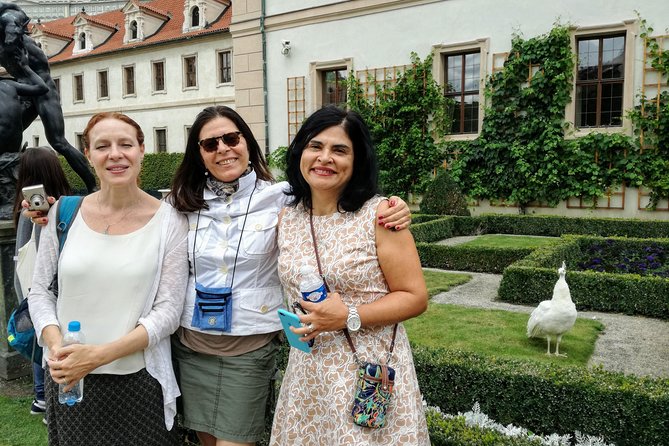
The artificial grotto adds a playful note. Its rough surface contrasts with the garden’s formal lines, while the aviary brings movement and sound into a carefully managed setting. Peacocks may also be present, adding an amusing touch of life to the stonework and geometry.
You have about 25 minutes here. That is enough to see the main features, but not enough for a slow, independent exploration of every corner. If you prefer setting your own pace, the group format may feel brisk. If you want interpretation and a useful overview, the timing works well.
Vrtbovská Garden and the climb to the top terrace
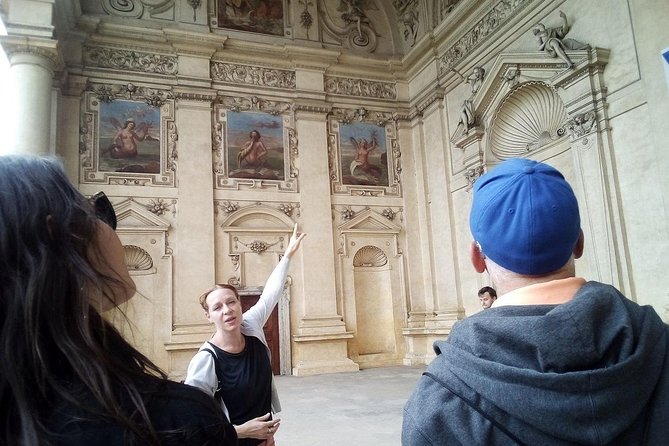
Vrtbovská Garden, often written as Vrtba Garden, is the most intimate stop. This walled Baroque garden dates from around 1720 and rises in terraces above Malá Strana.
The garden’s compact size is part of its charm. Instead of broad royal grounds, you get a tightly shaped space where stairs, statues, plants, and views work together. The original statuary and sculptural decoration carry layers of symbolism, and the guide explains how the design reflects Baroque taste.
The best reason to come is the view. From the upper terraces, you can look across Prague toward the castle and the city’s historic rooftops. It is a fine reminder that these gardens were designed not only to be seen, but also to frame the city beyond their walls.
There is a practical warning here. The route to the highest terrace includes steep stairs. If climbing is difficult, you can wait on the second terrace while the group continues, then reunite after about ten minutes. A private version can also modify this section for your group.
Admission is not included. The listed price is CZK 130 for an individual and CZK 100 for students and seniors. Carry enough Czech currency or confirm the current payment method before you arrive, since this fee is separate from the tour price.
The detailed stop information allows about 25 minutes at Vrtbovská Garden. That is enough for the main explanation and the upper view, though you may wish you had more time for photographs. The guide leaves you here in the longer route description, allowing you to continue your day on your own.
The meeting information also says the activity ends back at the starting point. Because those details differ, ask your guide at the beginning where the final handoff will be. That small check can save you an unnecessary walk or a rushed appointment.
What the $126.03 price includes
At $126.03 per person, this is not a bargain-priced walking tour. You are paying for a three-hour guided experience, a professional scholar guide, a group capped at eight, and a subject that requires more preparation than a standard city stroll.
The price makes the most sense if you care about art, architecture, garden design, royal history, or Prague’s less obvious sights. You get more than transportation between attractions. The guide supplies the connections that you would be unlikely to notice on your own, especially the relationship between sculpture and political propaganda.
It is less convincing value if you simply want to see gardens quickly and take pictures. You could visit some of these places independently for less, though you would miss the organized route and the explanations about plants, myths, and architecture.
Budget for extra admission. The fee information lists CZK 90 for the gardens under Prague Castle, reduced to CZK 60 for students and seniors, along with the Vrtbovská Garden charge. Another part of the tour description says garden admission is included except for Vrtbovská, so I would confirm exactly which castle entrance fees are covered when booking.
Group discounts are available, and mobile tickets make the meeting process simple. Free cancellation is allowed up to 24 hours before the start time. Changes or cancellations inside that window are not accepted for a refund.
Who will enjoy this walk most
I would recommend this tour to a repeat visitor who wants Prague to feel new again. Several local participants found fresh meaning in familiar places, especially after hearing how the statues and garden plans were chosen.
It also suits a first-time visitor who has already scheduled the major sights and wants a quieter half-day activity. The gardens offer a break from Prague’s busiest streets without taking you far from the city center.
Art lovers will get the most from the mythology and sculpture. Garden enthusiasts will appreciate the contrast between Renaissance planting, Italianate Baroque design, and the rising terraces of Vrtbovská. History fans will enjoy the connection between court life, science, travel, and political image-making.
I would think twice if you have very limited mobility, dislike stairs, or prefer to explore without a fixed pace. The tour requires moderate fitness, and the small group follows a planned route. You can skip the steepest climb, but the experience is still built around walking.
Should you book the Prague garden walk?
Book it if you want a thoughtful, specialist look at Prague rather than another fast pass through the famous sights. The strongest features are the tiny group, the scholar guide, the unusual plant stories, and the explanations of how mythology shaped the gardens.
Skip it if your main goal is a low-cost introduction to Prague or a relaxed stroll with little commentary. At $126.03, plus possible garden fees, the value depends on your interest in art and historical detail.
For the right person, this is a memorable way to spend three hours. You’ll see royal gardens, an Italian-style palace garden, a walled Baroque retreat, and some of Prague’s finest city views. Just confirm the final stop, budget for admission, and bring shoes suited to stairs.
FAQ
How long does the Prague Renaissance and Baroque Gardens tour last?
The guided walk lasts approximately three hours.
Where does the tour meet?
You meet at Bagel Lounge Malostranská, Letenská 118/1 in Prague’s Malá Strana, near Malostranská Metro station.
What departure times are available?
You can choose a 10am or 2pm departure.
How many people can join the tour?
The group has a maximum of eight people.
Is garden admission included?
The tour information says admission is included except for Vrtbovská Garden, while the fee details also list a CZK 90 admission charge for gardens under Prague Castle. Confirm the exact coverage when booking. Vrtbovská Garden costs CZK 130 for adults and CZK 100 for students and seniors.
Is the tour suitable for someone who has trouble climbing stairs?
The tour requires moderate physical fitness and includes steep stairs in Vrtbovská Garden. If you cannot make the highest terrace, you can wait on the second terrace and rejoin the group after about ten minutes.
Can I cancel for a refund?
You can cancel up to 24 hours before the experience starts for a full refund. Cancellations or changes made less than 24 hours before the start time are not accepted.
Just added around the world
- Yu Garden Shanghai Entry Tickets Booking And Trip★ 3.6 · 9 reviews
- Zanzibar: Jozani Monkeys, Butterfly Garden & Reptile Park★ 5.0 · 2 reviews
- York: Castle Howard Gardens and Grounds Entry Ticket★ 4.5 · 23 reviews
- York: Castle Howard House and Gardens – Self-Guided★ 4.8 · 120 reviews
- Royal Horticultural Society: Harlow Carr Garden Ticket★ 4.7 · 14 reviews
- Xochimilco floating gardens, Coyoacan and UNAM murals★ 4.0 · 6 reviews
- Woking: Royal Horticultural Society Wisley Garden Ticket★ 4.7 · 24 reviews
- Woodside: Filoli Historic House and Garden Entry Ticket★ 4.9 · 9 reviews
Tours, compared.

Skip-the-Line Tour of Palace and Gardens Access
Read our review →
Schönbrunn Palace & Gardens Skip-the-Line Tour
Read our review →
Alhambra & Gardens Tour w/Nasrid Palaces Option
Read our review →
Skip-the-Line Schönbrunn Palace & Gardens Tour
Read our review →
Cooking Class, Market & Thai Herbs Garden Tour
Read our review →
Versailles Palace Guided Tour & Gardens Access
Read our review →
Versailles Palace and Gardens Tour from Paris
Read our review →