
Review · GERMANY GARDEN TOURS
Sanssouci Park: A Self-Guide Audio Tour of the Garden’s Landmarks
Sanssouci Park is more than a pretty garden. It is Frederick the Great’s personal retreat, filled with royal follies, odd monuments, grand fountains, and even potatoes planted on a king’s grave. This self-guided GPS tour turns a large park into a story you can follow at your own pace.
I like the route’s strong sense of place, beginning at the Obelisk and finishing by the Church of Peace. I also like the freedom to stop for photos, linger at the Great Fountain, or finish in about an hour. The main drawback is that the tour does not include entry to the palaces, museums, or other attractions along the way, so admission costs can add up.
This is an English audio tour produced by Jo Eckardt, founder of A Friend in Berlin. You use the VoiceMap app, headphones, and your own smartphone. The app follows your position by GPS, provides turn-by-turn directions, and works offline after you download the tour.
Key points at a glance

- Royal stories with a potato twist: Hear why potatoes appear on Frederick the Great’s grave.
- A clear point-to-point route: Walk from the Obeliskportal near the Great Fountain to the Church of Peace.
- More than palace history: See the Neptune Grotto, Chinese House, Historic Mill, Orangery, fake ruins, and royal gardens.
- Flexible timing: The walk takes about 60 to 90 minutes, but you control when it starts and ends.
- Offline audio and maps: Once installed, the VoiceMap app works without a live internet connection.
- A low-cost introduction: At $9.99 per person, the tour costs less than many guided walks, though admission to attractions is separate.
Starting at the Obelisk and Great Fountain
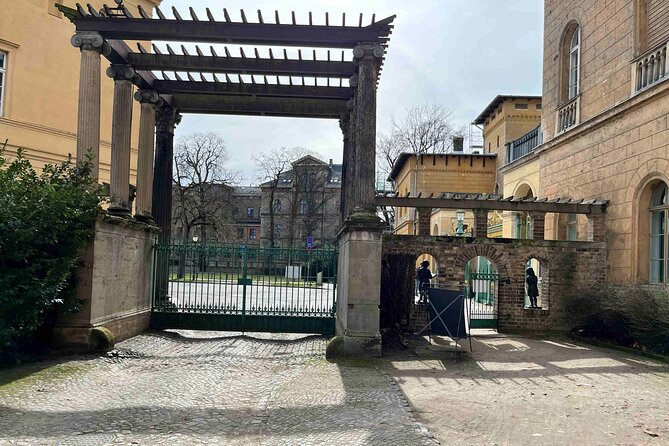
The tour begins at the Obeliskportal on Hauptallee, near the Great Fountain in Sanssouci Park. This is a sensible starting point because the fountain gives you an immediate sense of the park’s scale and design.
You will hear how Frederick II, better known as Frederick the Great, used Sanssouci as a private retreat. The name means without worries, which suits the king’s desire for a quieter place away from court life. His intimate Sanssouci Palace is part of that story, but this walk focuses on the surrounding park and its landmarks rather than taking you through palace interiors.
The Great Fountain is one of the best early photo stops. You are encouraged to pause here while the audio explains what you are seeing. That flexibility matters because a fixed group tour may give you only a few minutes, while this format lets you wait for a better view or simply enjoy the gardens in silence.
The park is a UNESCO World Heritage Site, and the route gives you a useful introduction without trying to cover every corner. You should expect a steady walk through open gardens and paths, not a museum tour or a formal lecture.
Self-guided tours around Germany:
- Berlin: Charlottenburg Palace & Gardens Ticket & Audio Tour
★ 4.2 · 9 reviews - E-ticket to Berlin Botanical Garden with Audio Tour
★ 5.0 · 2 reviews - From Paris: Versailles Palace Self Guided & Gardens tickets
★ 4.4 · 1,100 reviews
Frederick the Great’s Sanssouci retreat
Frederick the Great is the central figure of the experience. The audio explains why he loved Sanssouci so much and why he spent much of his time here. That personal angle gives the walk more warmth than a simple list of construction dates and royal names.
You will see how the park reflects the king’s taste for an intimate retreat. Sanssouci Palace was not planned as a giant ceremonial residence. The surrounding gardens, terraces, fountains, and statues helped create a place for private life, reflection, and pleasure.
This is one of the tour’s strongest features. You are not only looking at elegant buildings. You are hearing why the place mattered to the person who shaped it. That context helps connect the grand gardens with the quieter idea behind them.
The audio is especially useful if you are visiting Potsdam without a private guide. You get a route, historical background, and commentary from Jo Eckardt, rather than wandering from one monument to the next with no clear sense of how they fit together.
The Church of Peace and royal burials
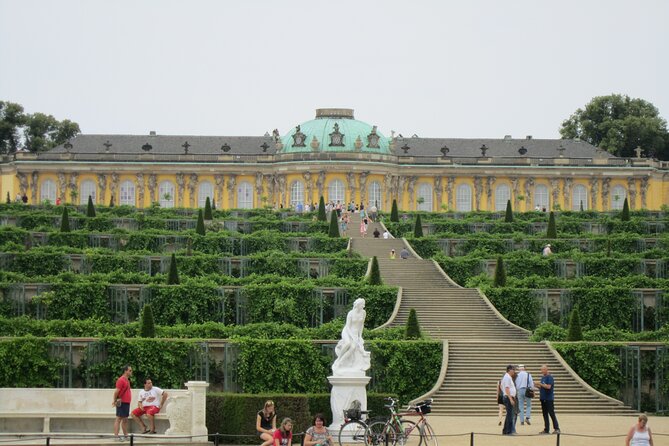
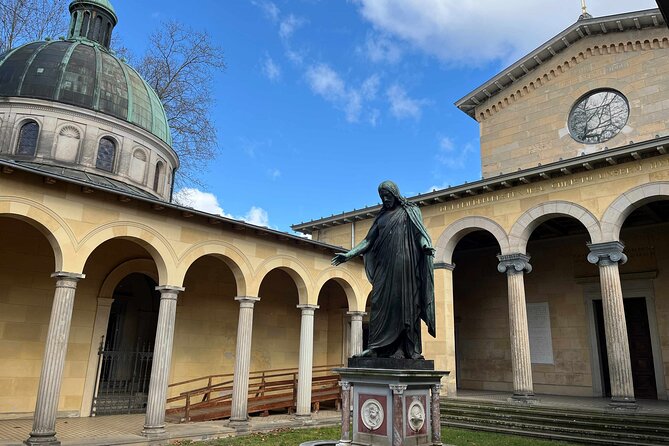
The walk passes several monuments on the way to the Church of Peace. The church is also the endpoint, so you finish with one of the park’s major landmarks rather than ending at a random gate.
The Church of Peace is connected with the Hohenzollern royal family, and many of the dynasty’s members are buried there. The tour uses the church to bring the story of the park and its rulers together.
You will not be guided through the church or any museum interiors. The audio tour stays outside the attractions mentioned along the route. If you decide to enter, you will pay separately and explore on your own.
That limitation is worth keeping in mind. The tour is best understood as an outdoor history walk, not a complete Sanssouci sightseeing ticket. It gives you the setting and the stories, while interior visits require extra time and money.
Neptune Grotto and the park’s playful side
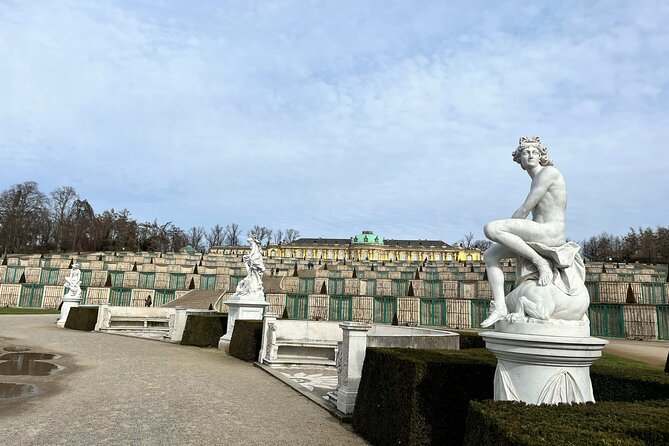
One of the more unusual stops is Neptune Grotto, a monument decorated with thousands of crystals and shells. It is the sort of detail that can be easy to miss if you are walking without commentary.
The grotto shows the decorative side of Sanssouci. This is not only a formal royal garden built around straight paths and grand buildings. It also contains theatrical touches, artificial ruins, mythological figures, and decorative structures designed to surprise.
The tour also points out undecipherable hieroglyphics and fake ruins associated with Sanssouci’s Courtyard Castle. These features add a little humor to the royal story. You see how historical gardens often mixed serious power with playful decoration.
I like this part of the route because it keeps the experience from becoming a string of palace facts. The odd details give you things to look for, and they help you remember the walk after you leave.
Audio tours around Germany:
- Tulip Fields near Keukenhof – Self-Drive Audio Tour for 2 People
★ 5.0 · 147 reviews - Lisse: Self-Guided Tulip Fields GPS Audio Tour
★ 4.6 · 83 reviews - Papal Palace and Secret Garden Ticket and Audio Guide
★ 3.9 · 73 reviews - Queluz: National Palace and Gardens E-Ticket & Audio Guide
★ 4.5 · 46 reviews
The grave of Frederick the Great and its famous potatoes
The Grave of Frederick the Great is one of the most memorable stops. The audio explains why potatoes are placed on the grave, a small custom with a direct link to the king’s agricultural policies.
This detail gives the tour one of its best human moments. You are not just hearing about a monarch’s titles, wars, and buildings. You are learning about a practical legacy that still appears at his resting place.
The grave also gives you a chance to think about the contrast between Frederick’s power and his wish for a personal retreat. Sanssouci was shaped by a king, but the park’s appeal comes from its intimate details as much as its royal scale.
If you are taking photos, this is a stop where the explanation matters more than the image alone. Without the audio, you might notice the potatoes but not understand why they are there.
The Historic Mill and views across Sanssouci
The route includes the Historic Mill of Sanssouci, a working mill with a beautiful view. It adds a practical, everyday element to the park’s royal setting.
A working mill may seem out of place beside palaces and formal gardens, but that contrast is part of what makes Sanssouci interesting. The site was not created as a single grand building surrounded by empty lawns. It was a working royal estate with gardens, service functions, views, and carefully arranged monuments.
The mill is also a good place to appreciate how the park spreads out. The audio helps you understand the relationship between the buildings and gardens, while the view gives you a reason to pause rather than simply pass by.
Keep in mind that the tour does not include entry into attractions. You can see the mill on the route, but any interior visit or separate attraction admission is your responsibility.
Orangery Palace and the later royal generation

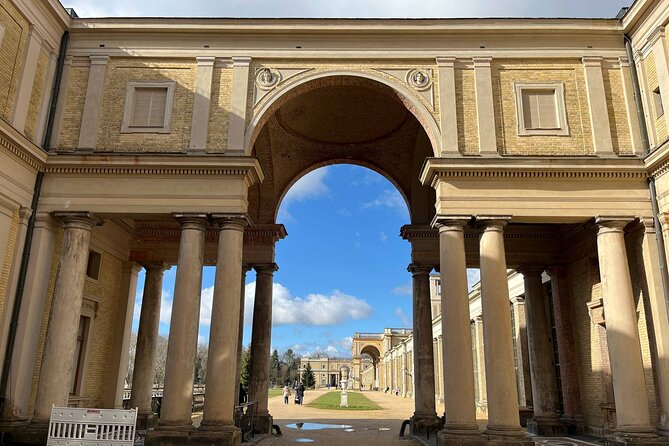
Orangery Palace brings another royal personality into the story. It was built for Frederick William IV, who loved Sanssouci Park almost as much as his grand-uncle, Frederick the Great.
This stop shows that the park did not belong only to one king or one period. Later members of the Hohenzollern family continued to shape and use it. The Orangery helps you see Sanssouci as a place that changed over time while keeping its original royal identity.
The building also adds variety to the walk. You move from Frederick’s intimate retreat to a larger and more formal palace associated with another generation. That difference makes the route feel broader than a single biography.
If you want to enter palaces along the way, allow extra time beyond the advertised 60 to 90 minutes. The audio walk itself is compact, but interior visits are not part of the tour and can change the pace considerably.
The royal gardens, vineyard, and 130,000 plants
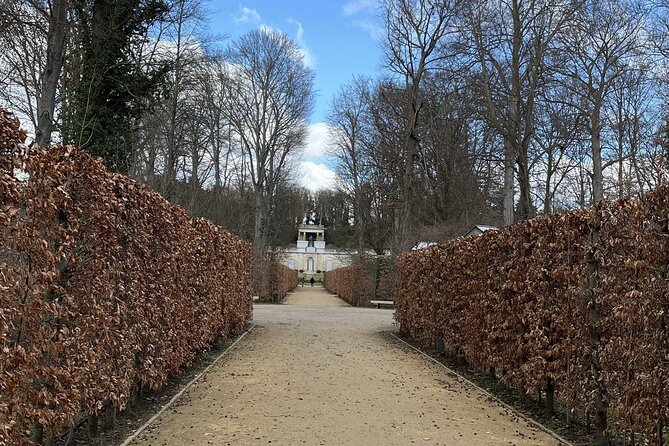
The gardens are not simply decoration between buildings. The route introduces more than 130,000 plants and flowers, including fig trees, a vineyard, and the last tree from the Royal Nursery.
Those details make the park feel like a living collection rather than a backdrop for palaces. You will see evidence of royal interest in cultivation, design, and imported plants. The vineyard and fig trees also help explain why the gardens feel different from a standard city park.
The figure of 130,000 plants gives you a sense of the work behind the views. The formal beauty depends on constant care, careful planning, and a long gardening tradition.
This is a good reason to avoid rushing. The basic route can fit into an hour, but the gardens reward a slower pace. You control the audio, so you can pause it while taking photos or looking closely at the plants.
The Chinese House and its not-so-Chinese statues
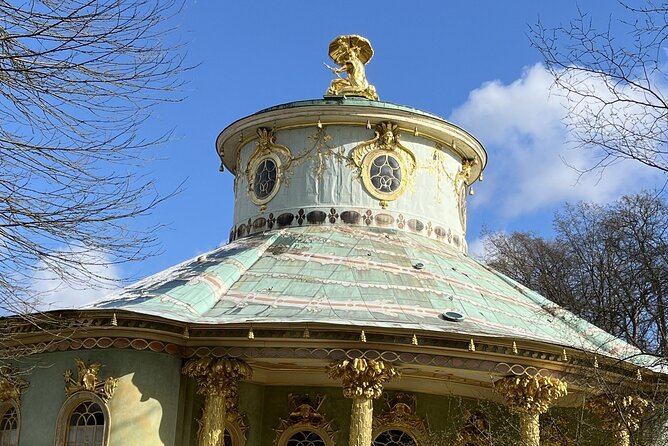
The Chinese House is one of the most distinctive landmarks in Sanssouci Park. The audio explains why the statues around the teahouse do not look Chinese, which gives you a useful way to question the building’s decorative style rather than accepting its name at face value.
The stop is valuable because it addresses the difference between European ideas about China and actual Chinese design. The building reflects the tastes and fantasies of its time, not a straightforward copy of Chinese architecture.
You will get more from this landmark if you look closely at the surrounding figures while the commentary plays. The statues are part of the story, not just decoration around a photogenic building.
This is another place where the tour’s flexibility helps. You can stop for several photos, compare details, and continue when ready. A group schedule would make that harder.
Flora, legends, and the final approach
The route passes Die Statue der Flora, giving the audio another chance to explain a smaller work that you might otherwise walk past. These short stops keep the experience moving while adding layers to the park’s decorative program.
By the time you reach the Church of Peace, the tour has covered royal ambition, personal retreat, garden design, practical agriculture, decorative fantasy, and family history. The final point brings you back to the Hohenzollern connection that appears earlier in the route.
The walk is designed to take about one hour to one and a half hours. That estimate works best if you keep moving and make only brief stops. If you linger at the fountain, take many photos, or enter attractions separately, plan on spending longer in the park.
The route ends just outside the Church of Peace at Am Grünen Gitter 3. Since it is a point-to-point walk, you should think about what you want to do next before starting. The supplied details do not include transportation, food, or drinks, so those are yours to arrange.
How the VoiceMap format works
After booking, you receive instructions and a unique code. Install the VoiceMap app for Android or iOS, enter the code, and follow the directions to the Obeliskportal.
When you reach the starting point, put on your headphones and tap Start. The app uses GPS to trigger the audio as you move, and it provides maps and turn-by-turn directions.
Offline access is a real advantage in a large park. Download the audio, map, and geodata before you begin so you are not depending on a live connection. You need to bring your own smartphone and headphones, since neither is included.
The tour also offers unlimited use before and after your booking date, along with a virtual tour option at home. That makes the $9.99 price more useful than a one-time timed performance. You can preview the route before arriving or revisit the commentary later.
Is $9.99 good value?
At $9.99 per person, this is a low-cost way to add structure and historical context to a visit to Sanssouci Park. The price is especially fair if you want a private experience for your own group without paying for a live guide.
The value depends on how you plan to visit. If you only want to stroll and take photos, you may not need an audio tour. If you want to understand why the landmarks are there, the commentary gives you much more than a map alone.
Remember that the price does not cover transportation, food, drinks, or admission to museums and attractions. The tour also cannot be refunded or changed after booking, so check your schedule before paying.
The experience has a rating of 3 based on two reviews, but one detailed review gave it five out of five and praised the route, context, and anecdotes about the Prussian kings. The limited number of ratings means you should judge the format itself: GPS audio, independent pacing, outdoor-only commentary, and no live guide.
Who should choose this walk?
I would recommend it to independent visitors who want more than an unstructured garden stroll. It suits people who like history in short sections, prefer to pause for photos, and do not need a live guide beside them.
It is also a good fit for a first visit to Sanssouci Park. The route links many of the main visual highlights and gives you a clear beginning and ending.
Families and mixed-age groups may appreciate the flexibility, since you can pause the tour whenever needed. The stories about potatoes, fake ruins, crystals, shells, and unusual statues also offer more variety than a long discussion of royal dates.
You should choose another option if you want guided access inside the palaces, a live conversation, transportation, or a tightly scheduled group experience. You should also allow extra time if the main goal is to tour palace interiors rather than explore the gardens.
Should you book the Sanssouci audio tour?
Book it if you want an inexpensive, flexible introduction to Sanssouci Park and enjoy exploring with your own group. The best reasons are the clear point-to-point route, the stories about Frederick the Great, and the small details that bring the gardens to life, from potatoes on a grave to shells in Neptune Grotto.
Skip it if you need museum entry, a live guide, or a fully arranged day. For most independent visitors, though, $9.99 is a reasonable price for a well-organized outdoor walk that helps you see the park as a royal retreat, working garden, and collection of wonderfully strange monuments.
FAQ
Where does the Sanssouci Park audio tour begin?
It begins at the Obeliskportal on Hauptallee, 14469 Potsdam, near the Great Fountain.
Where does the tour end?
The tour ends just outside the Church of Peace at Am Grünen Gitter 3, 14469 Potsdam.
How long does the tour take?
The estimated duration is about one hour to one and a half hours.
What app is used for the audio tour?
You use the VoiceMap app, available for Android and iOS.
Does the audio tour work offline?
Yes. The tour includes offline access to the audio, maps, and geodata.
Do I need to bring my own phone and headphones?
Yes. A smartphone and headphones are not included.
Does the tour include entry to the palaces or museums?
No. The tour does not guide you through museums or other attractions along the route. You must pay separately if you choose to enter them.
Is this a private tour?
Yes. Only your own group participates, and there is no shared group of other participants.
Is the tour available in English?
Yes. The tour includes lifetime access in English.
Just added around Germany
- Private Tour of Nymphenburg Palace and Gardens★ 5.0 · 26 reviews
- Private and full rickshaw tour in the English Garden★ 4.5 · 10 reviews
- Munich Private City Bike Tour and English Garden★ 4.5 · 2 reviews
- City Bike and English Garden Tour★ 4.0 · 14 reviews
- Amazing Schwetzingen Garden Tour★ 4.5 · 4 reviews
- E-ticket to Berlin Botanical Garden with Audio Tour★ 5.0 · 2 reviews
- Berlin: Potsdam & Sanssouci Gardens Private Tour With Jacob★ 4.8 · 8 reviews
- Cologne-Nippes: Summer wine party in the frenchstyle garden★ 4.7 · 3 reviews
Germany Garden Tours, compared.

Stuttgart: Wilhelma Zoological-Botanical Garden Ticket
Read our review →
Hanover: Royal Gardens of Herrenhausen Guided Tour
Read our review →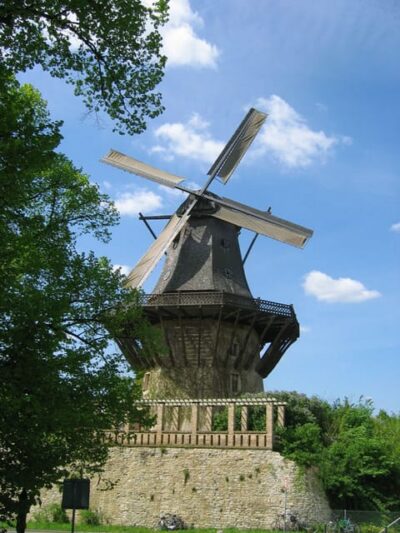



Heidelberg: Heidelberg Castle Garden & Outside Private Tour
Read our review →
Browse the lists this tour appears in