
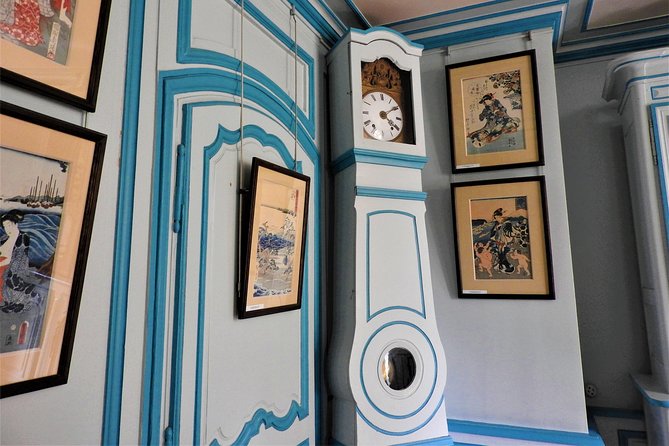
Review · FRANCE GARDEN TOURS
Giverny Monet House and Gardens Skip the line Walking tour
Giverny gives you the rare pleasure of stepping into a painter’s subject. You walk past Monet’s pink house, cross the Japanese bridge, and see the lily ponds that became some of his most familiar scenes. I especially like the village walk before the gardens and the small-group limit of 15, which can make the history easier to follow.
The skip-the-line entrance is useful during the busy April to October season, and guides such as Bernard, Mwamiri, Marine, and Bertrand have been praised for making Monet’s story lively. The main caution is crowd control: on peak days, even a small tour joins a very busy site, and some groups have had trouble hearing the guide.
Key points to know before booking
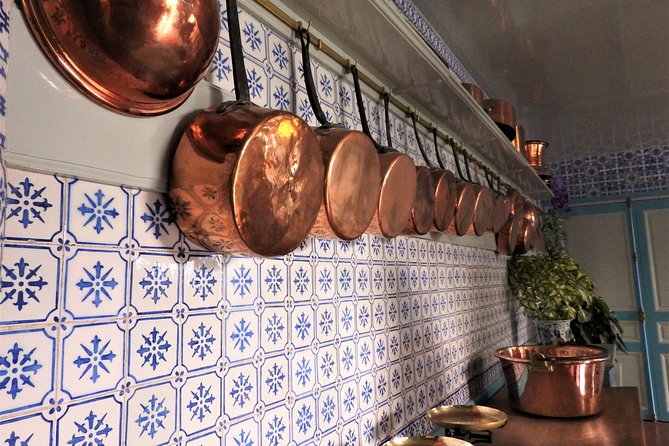
- Walk through Monet’s actual home and working surroundings, including the cheerful kitchen and his collection of Japanese prints.
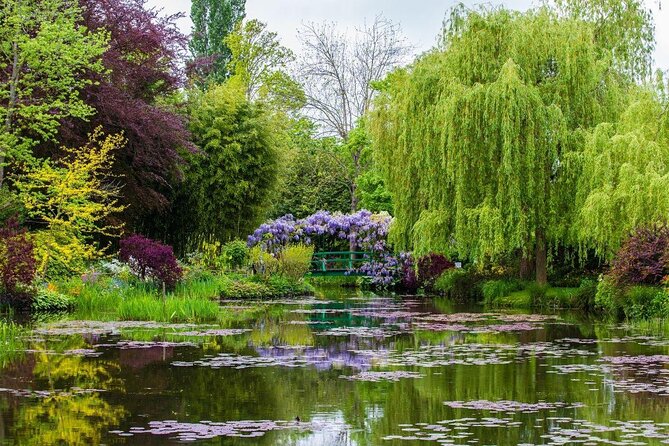
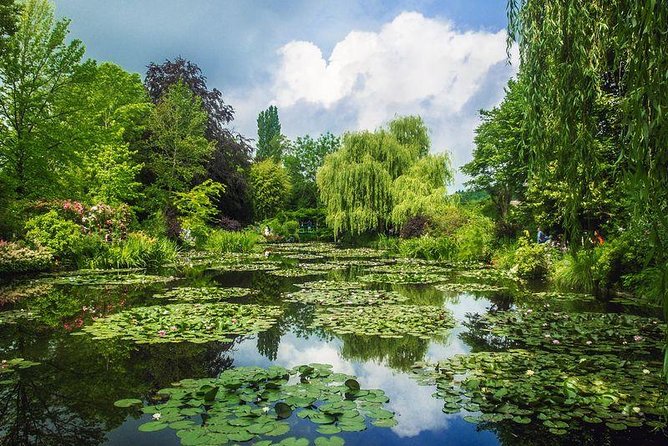
- See the famous Japanese-style gardens and lily ponds, with the bridge and willows that inspired his paintings.
- Begin with Giverny village, where Monet lived from 1883 until 1926 and helped draw artists such as John Singer Sargent, Paul Cézanne, and Mary Cassatt.
- Use a special entrance to avoid the main ticket line, a real advantage at popular times.
- Expect about two hours, with entrance fees and a local guide included but no transport, food, or drinks.
- Prepare for crowds and variable flower displays, especially in October, when some beds may be past their best.
Why Giverny feels different from a museum visit
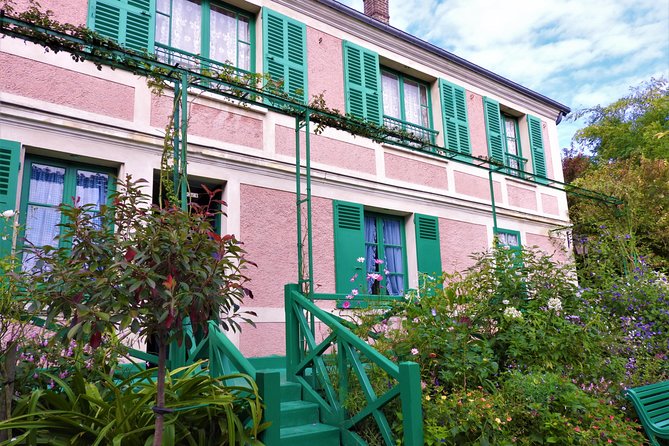
At a museum, you look at Monet’s paintings from a safe distance. In Giverny, you see the garden he designed, the ponds he painted, and the house where he spent decades working. That change of setting matters. The visit helps you understand that his paintings were not simply scenes he happened to find. He shaped much of what he saw.
The experience begins at La Capucine Giverny, 80 Rue Claude Monet. From there, your guide leads a walk through the village before taking you to the Fondation Claude Monet. This opening stroll gives you a sense of place and connects Monet to the village around him, rather than dropping you directly at the entrance and treating the house as an isolated attraction.
Monet lived in Giverny from 1883 to 1926. By 1887, the village had become a gathering place for artists. Your guide explains this period and places Monet within the wider Impressionist movement. The best guides use photographs and stories to make the names and dates easier to remember. Marine has been praised for telling good stories and keeping her group together, while Bernard has been singled out for filling in gaps even for people who already know a fair amount about Monet.
More Monet's Garden and Giverny in France:
- From Paris: Giverny, Monet’s Home & Gardens Half-Day Trip
★ 4.5 · 2,887 reviews - Giverny Monet’s Home and Gardens Half Day Tour from Paris
★ 4.5 · 1,836 reviews - Giverny Small-Group Half Day Trip with Monet’s Gardens from Paris
★ 5.0 · 1,663 reviews
The village walk comes first
The village portion is modest, but it adds useful context. You are not spending two hours inside the house and garden alone. You first see the setting where Monet lived and where other artists gathered around him.
This part is also where the tour feels most personal. A guide can point out details and explain Monet’s connection to Giverny in a way that a printed sign may not. You will also have the chance to pay respects at the cemetery of Giverny’s church, where Monet is buried, although the supplied schedule does not make clear how much time the group spends there.
The tradeoff is pace. A two-hour tour has to cover the village, house, and gardens, so the opening walk cannot be a long architectural tour. If your main goal is flower photography, you may wish the group reached the gardens sooner. If you want a clearer sense of Monet’s life, this first section earns its place.
Entering Monet’s house through the special entrance
The special entrance is one of the clearest practical reasons to book this experience. Monet’s house and gardens are popular, especially from April through October, and the regular entrance can develop long lines. The tour provides admission tickets through the guide and takes the group in through a separate access point.
Skip-the-line does not mean the site will be quiet. Once inside, you share the rooms and paths with many other people. At Easter and other busy periods, the gardens can feel crowded even when your entry is quicker. Still, avoiding a long wait is valuable when you have made the trip from Paris or are fitting Giverny into a full day.
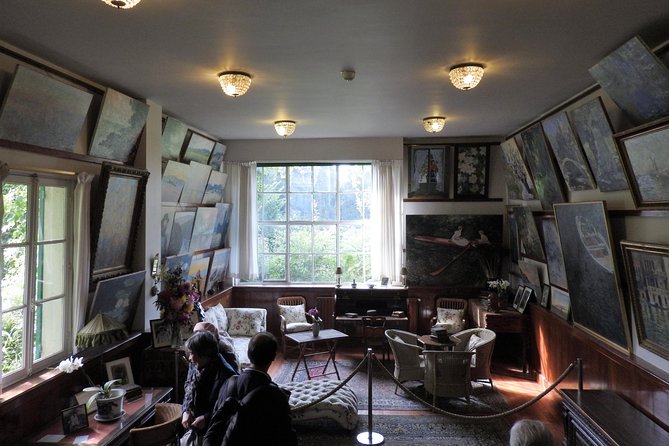
Inside the house, look for the lively kitchen and Monet’s collection of Japanese prints. These prints help explain the Japanese influence visible in the garden design. The house also contains original furnishings, which give the visit more substance than a simple room reconstruction.
One important expectation: this is not a museum of Monet’s original paintings. The house displays quality replicas of famous works, while the original paintings are held elsewhere. You come here for the home, gardens, furnishings, prints, and setting, not to see a major collection of original canvases.
The flower gardens and Oriental Water Garden
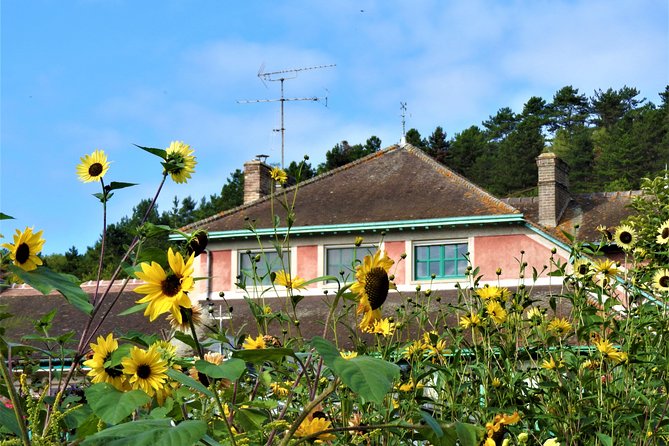
The gardens are the heart of the visit. From April to October, the beds can include wild roses, hollyhocks, poppies, and honeysuckle. The appearance changes sharply by month, so the same tour can feel like a different experience in May and October.
May is a strong choice if flowers are your priority. The beds can be bursting into bloom, and the color makes it easy to see why the gardens became central to Monet’s work. Families may find the gardens especially easy to enjoy because there are plenty of clear subjects for photographs, from flowers to water reflections.
October can still be lovely, and some flowers may remain. But you should not expect the same display as late spring. Parts of the garden may look past their best, particularly after poor weather. Rain does not necessarily spoil the visit, but it can make the paths less comfortable and the colors less predictable.
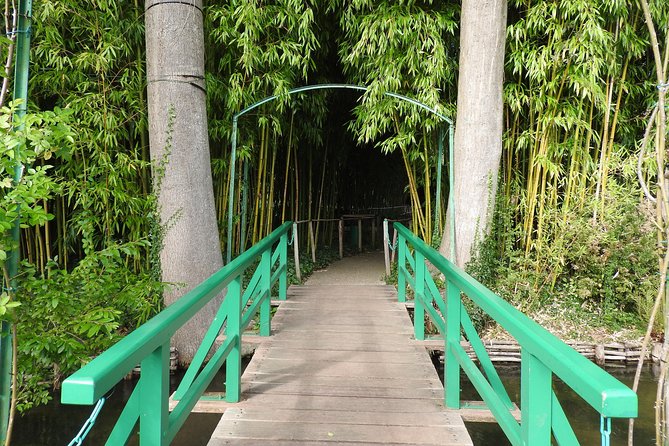
The Oriental Water Garden contains the features most closely linked with Monet’s paintings: water lilies, weeping willows, and the Japanese bridge. This is the point where the visit most clearly connects to the paintings you already know. You can see the composition in front of you, then notice how Monet altered it through light, season, and brushwork.
The setting is beautiful, but it is not always peaceful. Thousands of people can be present, particularly during school holidays and popular flower seasons. The tour guide’s job is partly to keep the group together while explaining what you are seeing. Mwamiri has been praised for doing just that, though crowd levels can make any guide’s job harder.
Skip-the-line tickets around France:
- Versailles: Skip-the-Line Tour of Palace and Gardens Access
★ 4.7 · 10,429 reviews - Skip-the-Line Versailles Palace & Garden Tour with Transport
★ 4.6 · 858 reviews - Giverny Village Walking Tour & Skip-the-Line to Monet Garden
★ 4.0 · 595 reviews - From Paris: Skip-the-Line Versailles Palace & Gardens Tour
★ 4.3 · 551 reviews
How the guide affects the experience
The guide can turn a pleasant garden visit into a meaningful art and history lesson. The strongest guides explain Monet’s life, his role in the Impressionist movement, his friendships with other artists, and the way the garden relates to his paintings.
The guide quality has not been identical on every departure. Bernard, Mwamiri, Marine, Bertrand, and a guide described as being from Virginia have all received warm praise for their energy, stories, kindness, and ability to manage the group. That suggests the tour can be excellent when you get a strong guide.
There are also practical weaknesses. One departure was much larger than expected, with 22 people, despite the stated maximum of 15. The group also had to accommodate French-speaking participants on an English tour, so the guide translated everything. That slowed the presentation and made it harder for people at the back to hear.
Another group reported a guide who spoke only intermittently and did not use a headset, while other tour groups had audio equipment. In a crowded garden, this matters. If you are at the rear of a long line, voices can fade quickly. Stay close to the guide, especially when the group moves between the house and water garden.
The stated group limit of 15 is a good feature, but you should still confirm the group size at the start. Small groups are easier to manage, easier to hear, and better suited to questions. The real experience depends on both the guide assigned to your departure and the crowd level at the foundation.
Is the $63.86 price fair?
At $63.86 per person, this is not the cheapest way to visit Giverny. You are paying for more than admission, though. The price includes entry to Monet’s house and gardens, a village walk, and a local guide who explains what you are seeing.
The value is strongest if you want context or dislike handling tickets and navigation yourself. The skip-the-line access can also save time at a busy period. If you have only one chance to see Giverny and want the visit organized around Monet’s life, the added cost can make sense.
The value is weaker if you prefer to move at your own speed and read information on your own. One harsh assessment found that arriving early and touring independently would have been better. That view is understandable, particularly if the guide is weak or the group becomes too large.
The tour is booked, on average, 39 days ahead, which signals strong demand. It does not prove that every departure is equally good, but it does suggest you should not leave this decision until the last minute if your dates are fixed.
Getting to the meeting point
Transport is not included. You must reach La Capucine Giverny at 80 Rue Claude Monet, and the activity ends back at that meeting point.
This detail is easy to miss when planning from Paris. Some people take the train from Paris to Vernon and then use the shuttle to Giverny. That route can be straightforward, but the shuttle connection is part of your own planning, not part of this tour. Pick-up and drop-off are not included.
Driving requires care. Parking can be difficult, particularly during busy periods, and one visitor abandoned the visit after spending a long time trying to find a space. Give yourself more time than the meeting schedule alone suggests. You must arrive 15 minutes early because the tour begins promptly, and late arrivals risk missing the group.
A mobile ticket is provided, and confirmation arrives when you book. Service animals are allowed, public transportation is nearby, and most people can take part. The walking portion, garden paths, and crowds still make comfortable shoes a sensible choice, though the supplied information does not specify accessibility details for every path or room.
What the two-hour schedule means
Two hours is enough for an introduction to the village, house, and gardens, but it is not a leisurely full-day visit. Your guide has to keep the group moving, especially when the foundation is crowded.
This format suits you if you want the main sights and a clear explanation of Monet’s connection to Giverny. It is less suited to a serious garden enthusiast who wants to study every bed, or to a photographer who needs long stretches without people in the frame.
Several departures have left people with free time after the guided portion to explore the village. That is useful, but do not assume the tour includes an extended independent visit inside the foundation. The listed duration is about two hours, and the formal activity ends back at the meeting point.
Who should book this Giverny tour?
I would choose this tour for a first visit, especially if Monet is important to you and you want the house and garden to make sense as one story. It also suits anyone who values a guide, wants to avoid the main entrance line, or feels uneasy arranging the Vernon to Giverny connection alone.
Families can enjoy it because the gardens offer constant visual interest, and the small group can make it easier to keep children close. Art lovers will appreciate the explanation of Monet’s circle, while casual visitors can simply enjoy the flowers, bridge, water, and house.
I would think twice if you strongly prefer independent touring. You may find the pace too brisk, the crowd too thick, or the commentary too uneven. I would also be cautious about booking a tight schedule around the tour if you are driving, since parking can take longer than expected.
Cancellation is free up to 24 hours before the start time. Changes or cancellations inside that 24-hour window are not accepted for a refund. The experience also requires a minimum number of participants, so an operator cancellation can result in another date or a full refund.
Should you book it?
Book it if you want Monet’s life and garden design explained as you walk, and if skipping the main entrance line is worth paying for. The best guides, including Bernard, Mwamiri, Marine, and Bertrand, can add real value, particularly when they use stories and images to connect the rooms and gardens to the paintings.
Choose an independent visit instead if you are comfortable arranging transport, arriving early, and setting your own pace. Either way, allow extra time for parking or the shuttle, arrive 15 minutes early, and plan around the season. May offers the safest bet for flower displays, while October can still be beautiful but is less predictable.
FAQ
How long does the Giverny Monet House and Gardens tour last?
The activity lasts about two hours, including the village walk and the visit to Monet’s house and gardens.
Where does the tour begin?
It begins at La Capucine Giverny, 80 Rue Claude Monet, 27620 Giverny, France.
Where does the tour end?
The activity ends back at the meeting point.
Are entrance fees included?
Yes. Admission to Monet’s house and gardens is included.
Does the tour include transportation?
No. Pick-up and drop-off are not included. You must make your own way to the meeting point.
How many people can join the tour?
The group is advertised as having a maximum of 15 participants.
Do I need to arrive early?
Yes. Arrive 15 minutes before the scheduled start. The tour begins promptly, and latecomers may miss it.
Can I cancel for a refund?
You can cancel up to 24 hours before the scheduled start for a full refund. Cancellations or changes made less than 24 hours before the start are not accepted for a refund.
Just added around France
- Versailles: Skip-the-Line Versailles Palace and Gardens Tour★ 4.7 · 110 reviews
- Giverny Village Walking Tour & Skip-the-Line to Monet Garden★ 4.0 · 595 reviews
- Gorges du Verdon : Lavenders, Canyon Boat Picnic & Villages★ 5.0 · 22 reviews
- Giverny: Monet’s House & Gardens Private Guided Tour +Ticket★ 4.1 · 29 reviews
- Giverny : Monet’s house & Gardens Private tour from Paris★ 5.0 · 5 reviews
- From Paris: Versailles Palace & Garden with Golf Cart★ 4.8 · 5 reviews
- From Paris: Giverny & Monet’s House Skip-the-Line Tour★ 4.4 · 10 reviews
- From Paris: Versailles Palace & Gardens with Transportation★ 4.9 · 13 reviews
France Garden Tours, compared.

Versailles Palace and Gardens Full Access Ticket
Read our review →
Skip-the-Line Tour of Palace and Gardens Access
Read our review →
Versailles Palace Guided Tour & Gardens Access
Read our review →
Versailles Palace and Gardens Tour from Paris
Read our review →
Giverny, Monet’s Home & Gardens Half-Day Trip
Read our review →
Gorges of Verdon and Fields of Lavender Tour
Read our review →
Versailles Full Day Bike Tour with Palace, Gardens, & Picnic
Read our review →
Versailles Bike Tour w/ Palace, Gardens, & Picnic
Read our review →Browse the lists this tour appears in