
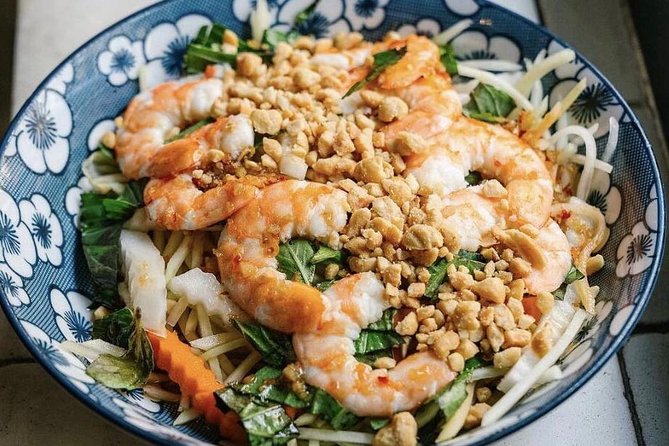
Review · VIETNAM GARDEN TOURS
Home Cooking Class: Market, Garden and cooking 4 dishes
The best part of this Da Nang experience is that you do not simply watch someone cook. You help choose the ingredients at Han Market, work in a vegetable garden, then prepare four dishes in a local home before sitting down to eat. The market-to-table flow gives the class a useful sense of place.
I especially like the small group, limited to nine people in the main description and no more than ten in the additional details. I also like that the cooking is genuinely hands-on, with English recipe copies to take home. The main thing to consider is timing: the menu changes by day, and pickup is offered for the full tour but not for the cooking-class-only option.
Key points at a glance
- Four dishes, not a demonstration: You prepare the food yourself, with guidance from an English-speaking instructor.
- Han Market comes first: You learn about Vietnamese ingredients while selecting the food used later in class.
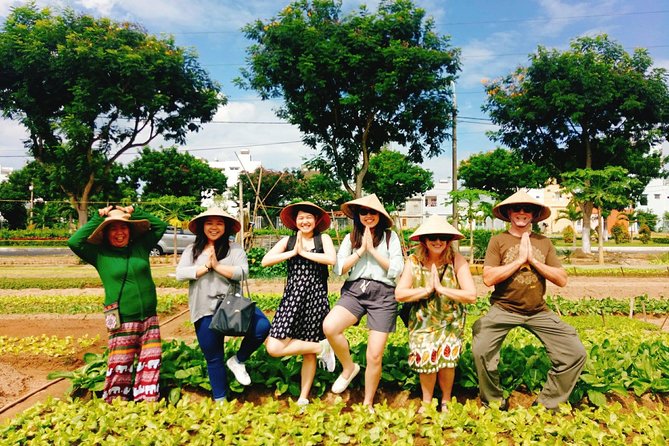
- A short farming session adds context: You join local farmers in preparing land and growing vegetables.
- Menus change by day: Beef noodle soup and banh xeo appear on some days, while Quang noodles and fish sauce chicken wings appear on others.
- A small group keeps it personal: The experience is designed for a maximum of nine to ten people.
- The $26 price covers the essentials: Ingredients, water, dessert, recipes in English, the market visit, farm activity, and full-tour pickup are included.
From Han Market to the cooking table
This is a four-hour experience built around a simple idea: food makes more sense when you see where it starts. You begin with a hotel pickup in central Da Nang, either from 8:00 to 8:30 in the morning or from 2:00 to 2:30 in the afternoon.
The first scheduled stop is Han Market. You may also pass Da Nang Cathedral as part of the route, but the market is the main attraction. This is where you learn about the ingredients that shape Vietnamese cooking and help select fresh produce for the class.
I like this opening because it gives you something to watch for later. Instead of treating herbs, noodles, shrimp, or green papaya as anonymous items on a recipe sheet, you see them in their everyday setting first. The emphasis is on freshness and local buying, not on a staged food show.
The market visit is also useful for anyone who feels uncertain about Vietnamese ingredients. An instructor can explain what you are looking at and how it will be used. Guides named in the experience include Jane, Nhi, Lyn, and Anna, though your instructor depends on the date.
Do not expect the market stop to be a long sightseeing tour with a separate lecture on every stall. It is part of a working food trip. You are there to understand the ingredients and help gather what the group will cook.
Cooking classes around Vietnam:
- Cooking Class Hoi An – Organic Garden – Farming Tour-Handicrafts
★ 5.0 · 56 reviews - Hue’s Vegetarian Cooking Class in Ancient Garden
★ 5.0 · 47 reviews - Viet Garden Cooking Class (Countryside and Market tour)
★ 4.8 · 12 reviews
Working the garden before cooking
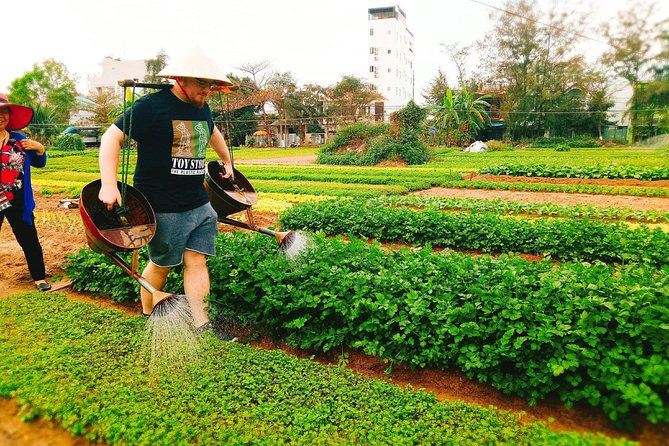
After the market, the experience moves to vegetable gardens. You join farmers in preparing soil and growing vegetables, then get a short taste of farm work yourself.
This part matters because Vietnamese cooking often depends on fresh herbs and vegetables rather than heavy sauces alone. A garden visit connects the finished meal to the work behind it. You are not only learning how to roll a spring roll or mix a salad. You are also seeing the care that goes into the raw ingredients.
The farming activity is not presented as a full agricultural course. It is a practical visit with a chance to work alongside local people and get your hands involved. One useful detail from the experience is that the garden can be a highlight for people who grew up around rural life, as well as for city residents who rarely get close to food production.
Wear clothes and shoes you do not mind using outdoors. The provided information does not specify the amount of physical work, so you should expect a light activity rather than plan for a demanding farm day. Water is included, which is welcome in Da Nang’s heat.
A local house and four dishes
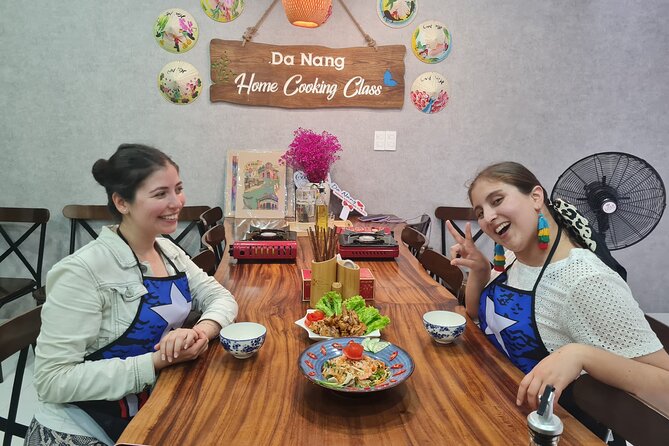
Around 9:15 in the morning or 3:15 in the afternoon, you reach a local house for the cooking class. This is where the experience becomes personal. You work with a local family and prepare four traditional dishes, then eat the meal you helped make.
The format suits you if you learn by doing. You are not sitting at a long table while an instructor handles every knife, pan, and bowl. The class is described as hands-on, and the strongest praise goes to the patient teaching style of instructors such as Jane, Nhi, and Lyn. Lyn’s mother and Sophia have also helped with demonstrations and kitchen instruction.
The instructors’ personalities matter here. Jane is noted for patiently guiding the group through dishes such as papaya salad, fresh spring rolls, crispy savory pancakes, and beef pho. Nhi is described as a warm host, while Lyn is praised for her English and for helping conversations flow. Anna has led market introductions for family groups.
You should still keep your expectations practical. A group class cannot give every person unlimited one-on-one time. The cap of nine to ten people helps, but some steps will naturally move at a shared pace. If you want a private cooking lesson with the instructor focused only on you, this is not that format.
The reward is the meal at the end. You sit down to eat the four dishes, along with dessert. Since you have handled the ingredients and cooking, lunch or dinner feels more satisfying than a meal ordered from a menu. It also gives you a chance to compare your results with the instructor’s guidance.
The rotating menus and what they mean
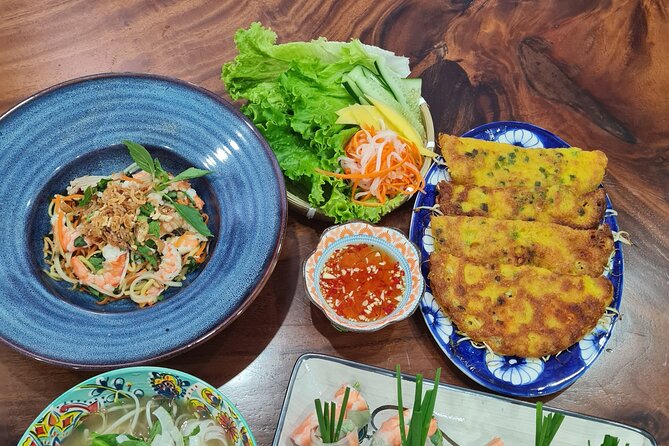
The menu depends on the day you book. This is one of the most important practical details, since you cannot assume you will cook every dish listed.
More Garden Tours in Vietnam:
- Mekong Delta Homestay 2-Day at Family Tiny Garden – Small Group
★ 5.0 · 410 reviews - Botanic Garden – Paradise Cave – Zipline – Mudbath at Dark Cave
★ 5.0 · 79 reviews - Can Tho Floating Market and Fruit Garden Tour
★ 5.0 · 40 reviews - Can Tho: Cycling in Village-Fruit Garden-Experience Local Ferry
★ 5.0 · 24 reviews
Monday, Wednesday, Friday, and Sunday
- Quang noodles
- Fish sauce chicken wings
- Green papaya salad with shrimp
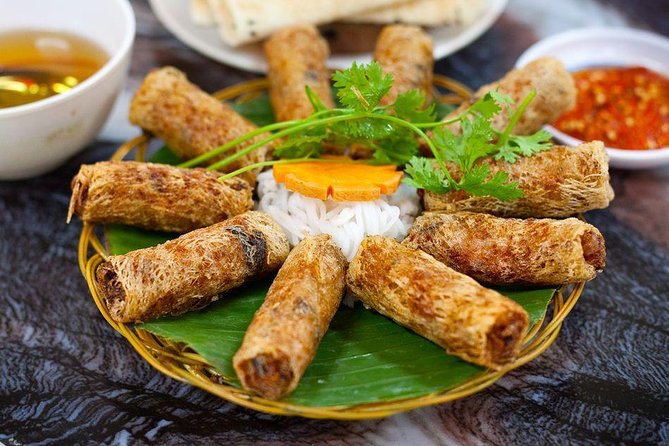
- Deep-fried spring rolls
This menu gives you a broad introduction to central Vietnamese flavors. Quang noodles are closely associated with central Vietnam, while the papaya salad brings a fresh, crisp contrast to the richer chicken wings and fried spring rolls.
The deep-fried spring rolls are a good hands-on dish because the wrapping and shaping are part of the lesson. The salad also teaches balance: fresh vegetables, shrimp, herbs, and dressing need to work together rather than simply taste sweet or salty.
Tuesday, Thursday, and Saturday
- Beef noodle soup
- Crispy Vietnamese pancakes, banh xeo
- Green mango salad with shrimp
- Fresh spring rolls
This menu has a different rhythm. Beef noodle soup takes you into broth and seasoning, while banh xeo teaches a crisp pancake technique. The mango salad is fruitier and sharper than the papaya version, and fresh spring rolls give you a lighter, uncooked preparation.
Banh xeo can be especially useful for anyone who wants to understand Vietnamese street food beyond restaurant ordering. The dish is more than a pancake. You learn how to handle the batter and combine it with fillings and fresh accompaniments.
The soup menu may require more patience than the fried and rolled dishes. The supplied details do not state how long broth preparation takes, so the instructor will determine which parts are prepared ahead and which parts you handle. You still get exposure to the process rather than only receiving a finished bowl.
Check the weekday menu before booking. If your priority is pho-style beef noodle soup, banh xeo, mango salad, and fresh spring rolls, choose Tuesday, Thursday, or Saturday. If Quang noodles and deep-fried spring rolls appeal more, choose Monday, Wednesday, Friday, or Sunday.
Why the small group matters
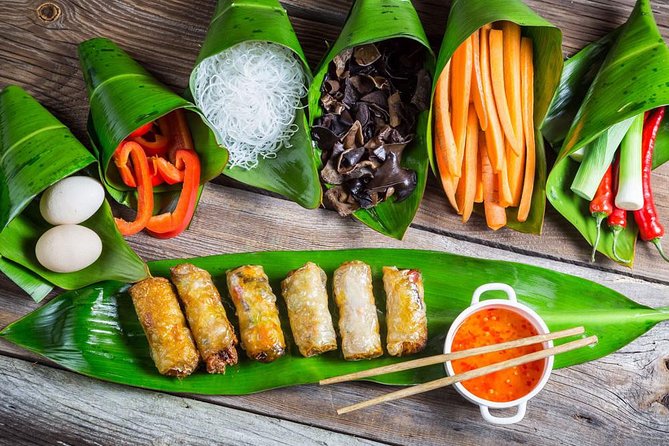
A maximum of nine people, or ten according to the additional capacity note, is a strong feature for this kind of class. Cooking involves small tasks, quick demonstrations, and questions that can get lost in a large group.
With fewer participants, you have a better chance of handling ingredients yourself and asking why a particular sauce, noodle, or vegetable is used. It also makes the local-home setting feel less like a production line.
The small size does not remove every limitation. If several people are eager to do the same task, you may need to share turns. Still, the group size is much more suitable for a cooking class than a large coach outing.
The experience also works well for different kinds of groups. Families can divide tasks among parents and children, friends can cook together, and couples can use the class as a shared activity. One family group especially enjoyed the combination of market time and instruction, which makes sense: the class offers movement and conversation before the meal.
What the $26 price includes
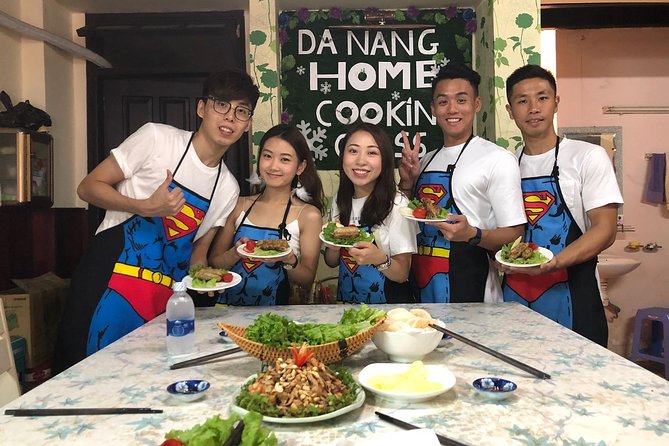
At $26 per person, the value is strong if you want more than a single meal. You receive roughly four hours of activity, a market visit, a farm session, instruction, four dishes, ingredients, water, dessert, and recipes in English.
The recipes are important. A cooking class has limited value if everything stays in the instructor’s kitchen. With written copies, you can try to recreate the dishes later, even if you need to adjust ingredients available at home.
The price also includes pickup for the full tour from hotels in central Da Nang. Drop-off is not included. The details also distinguish the full tour from the cooking-class-only option: pickup and drop-off are not included with the class-only choice.
That distinction can affect the real cost. If you book the full experience, factor in your own return transport after the tour ends at noon or 6:00 in the evening. If you choose the cooking-only version, confirm your transport plan before you go.
The price does not include a list of optional extras, which keeps the cost easy to understand. Ingredients are included, so you are not shopping for the class out of pocket. For four hours of activity and a full meal, $26 is reasonable, especially if you value local contact and practical learning.
Timing, pickup, and the heat of Da Nang
You can choose a morning or afternoon schedule. The morning option runs from approximately 8:00 until noon. The afternoon option begins around 2:00 and ends around 6:00.
The morning session gives you a cooking lunch. The afternoon session leads to dinner. Choose based on your day, but also consider the heat. The garden work may feel more comfortable in the morning, though the experience offers both schedules.
Pickup is offered from hotels in central Da Nang for the full tour. The exact pickup window is 8:00 to 8:30 or 2:00 to 2:30, so be ready at the start of that window rather than waiting until the final minutes.
The experience requires good weather. If poor weather causes cancellation, you can receive a different date or a full refund. A minimum number of participants is also required, and a cancellation for that reason offers the same choice of another date or a refund.
You can cancel for a full refund up to 24 hours before the start time. Changes made within 24 hours are not accepted, and late cancellations are not refunded. Those rules are worth noting if your Da Nang schedule is still shifting.
The best parts, and the limits
The most praised feature is the combination of people and activities. The instructors receive repeated credit for being friendly, patient, and helpful. That matters more here than polished presentation. Cooking beside a local family works only when the teaching feels relaxed and clear.
The second major strength is variety. You visit a market, work in a garden, cook, and eat. If you prefer a day with several types of activity, this is more rewarding than a class held entirely indoors.
The meal itself is another clear advantage. Four dishes can be a lot of food, and you may not finish everything. That is useful to know if you have a small appetite. You are paying for instruction and a meal, not just a tasting menu.
The limits are modest but real. The class is not a deep tour of Da Nang Cathedral or Han Market as historic sights. The market is used to explain ingredients, and the cathedral is listed as a stop, but the main purpose is cooking.
Also, the menu is fixed by weekday. If you have dietary restrictions, the supplied information does not confirm substitutions. Ask before booking rather than assuming the instructor can change every dish.
Who should book this experience
I would choose this class if you want to understand Vietnamese food through ordinary ingredients and shared work. It is a good match for first-time visitors who want a local activity without committing to a full-day excursion.
Families should find the changing tasks useful, though the farming and cooking portions may require children to follow instructions closely. Couples and small groups will appreciate the capped size and the chance to eat together afterward.
The experience is less suitable if you want a formal chef-led lesson, a luxury kitchen, or a highly specialized focus on one dish. It is also not the best pick if you need a guaranteed menu change, since no dietary substitutions are stated.
For most people, the strongest reason to book is the complete arc: buy ingredients, see where vegetables grow, cook four dishes, and eat the result. That sequence gives the $26 price real value.
Should you book the Da Nang Home Cooking Class?
Yes, if you want a friendly, active food experience with a local family and enough structure to keep the morning or afternoon moving. The 4.8 rating from 61 ratings and 95 percent recommendation fit the experience’s strongest points: patient guides, good food, useful market time, and a personal group size.
Book with the menu in mind. Pick Monday, Wednesday, Friday, or Sunday for Quang noodles and deep-fried spring rolls. Pick Tuesday, Thursday, or Saturday for beef noodle soup, banh xeo, mango salad, and fresh spring rolls.
I would also choose the full tour rather than the cooking-only option if you want the market and garden portions, since those are what make this more than a standard class. Confirm your hotel is in central Da Nang for pickup, plan your return transport, and leave enough room for a large meal.
FAQ
How long does the cooking experience last?
The experience lasts approximately four hours. The morning schedule runs from about 8:00 AM to 12:00 PM, and the afternoon schedule runs from about 2:00 PM to 6:00 PM.
Where does the tour begin?
Pickup is offered from hotels in central Da Nang for the full tour. The route includes Han Market and lists Da Nang Cathedral as a stop.
Is hotel pickup included?
Pickup is included for the full tour option from hotels in central Da Nang. Pickup and drop-off are not included with the cooking-class-only option.
How many dishes will I cook?
You will prepare four traditional Vietnamese dishes during the hands-on cooking class.
Does the menu change by day?
Yes. Monday, Wednesday, Friday, and Sunday feature Quang noodles, fish sauce chicken wings, green papaya salad with shrimp, and deep-fried spring rolls. Tuesday, Thursday, and Saturday feature beef noodle soup, banh xeo, green mango salad with shrimp, and fresh spring rolls.
Are ingredients included?
Yes. All ingredients, water, dessert, and copies of the recipes in English are included.
Is the class taught in English?
Yes. An English-speaking instructor leads the experience.
Can I cancel for a refund?
You can cancel at least 24 hours before the start time for a full refund. Cancellations or changes made less than 24 hours before the start time are not accepted for a refund.
Just added around Vietnam
- Hue’s Vegetarian Cooking Class in Ancient Garden★ 5.0 · 47 reviews
- Cooking Class Hoi An – Organic Garden – Farming Tour-Handicrafts★ 5.0 · 56 reviews
- Garden Bay Cruises – Traditional Wooden Boat to Bai Tu Long Bay★ 3.0 · 2 reviews
- Explore Untouched Bai Tu Long: 2-Day Garden Bay Cruise Journey★ 5.0 · 12 reviews
- Botanic Garden – Paradise Cave – Zipline – Mudbath at Dark Cave★ 5.0 · 79 reviews
- Can Tho day tour: fruit garden&floating fish farm in Son islet★ 5.0 · 4 reviews
- Can Tho Floating Market and Fruit Garden Tour★ 5.0 · 40 reviews
- Can Tho Countryside Bike Tour with Fruit Garden Visit★ 5.0 · 12 reviews
Vietnam Garden Tours, compared.
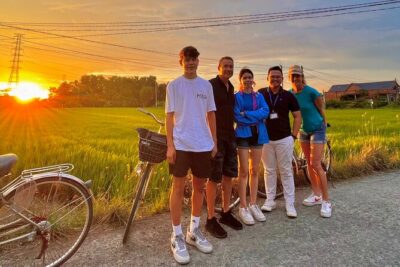
Mekong Delta Homestay 2-Day at Family Tiny Garden – Small Group
Read our review →
Botanic Garden – Paradise Cave – Zipline – Mudbath at Dark Cave
Read our review →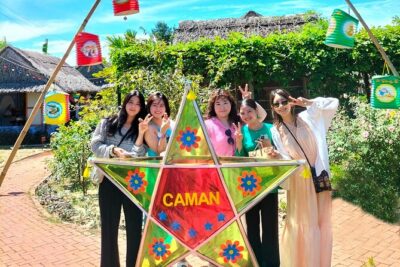
Cooking Class Hoi An – Organic Garden – Farming Tour-Handicrafts
Read our review →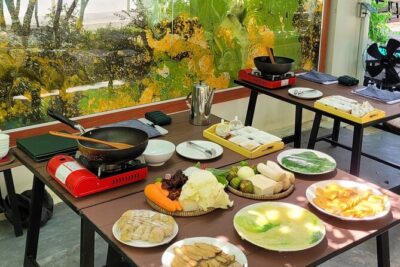
Hue’s Vegetarian Cooking Class in Ancient Garden
Read our review →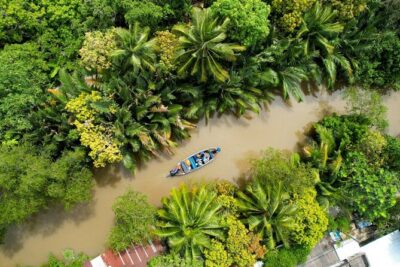
Can Tho: Cycling in Village-Fruit Garden-Experience Local Ferry
Read our review →
Viet Garden Cooking Class (Countryside and Market tour)
Read our review →
Can Tho Countryside Bike Tour with Fruit Garden Visit
Read our review →Browse the lists this tour appears in