
Review · CHIANG MAI GARDEN TOURS
Cooking Morning Class Chiang Mai Visit Organic Garden and Market
The best part of this Chiang Mai class is the mix of market, garden, and kitchen. You begin by learning about Thai produce at a local market, then pick herbs at the school’s organic garden before preparing six dishes of your choice. Gift and Cream are among the instructors praised for keeping the class friendly and easy to follow.
I like the one-person-per-wok setup, which gives you real control over your food, including the spice level. I also like the flexible menu, with vegetarian, vegan, gluten-free, and allergy options. The main thing to consider is the class size: some sessions are intimate, while others can be quite large, and several ingredients may already be partly prepared.
Quick points to know
- Six dishes, chosen by you: Pick one appetizer, curry paste, curry, stir-fry, soup, and dessert.
- A real market visit first: Learn about Thai fruits, rice, vegetables, and cooking ingredients before class.
- Individual cooking stations: You get your own wok and mortar for the curry paste.
- Organic garden stop: See herbs and spices growing before using them in your meal.
- Pickup from Chiang Mai Old Town: Transport is included from select Old Town hotels.
- Good value at $13.04: The price includes ingredients, instruction, lunch, drinks, transport, and an online recipe book.
A market morning before the cooking begins
The day starts with hotel pickup between 9:00 and 9:30 a.m. from select hotels in Chiang Mai Old Town. If your hotel is outside the included pickup area, the stated meeting point is The Pizza Company at Ruamchok Mall. The activity ends back at the meeting point after the return drive.
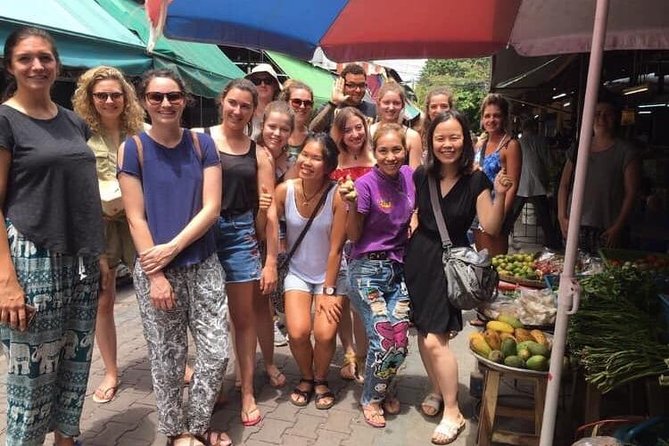
The first proper stop is a local market at about 10:00 a.m. This is not just a quick walk past food stalls. Your instructor explains the fruits, vegetables, rice, herbs, and other ingredients used in Thai cooking. It gives you useful context before you start chopping and frying later in the morning.
I like this opening because Thai ingredients can be confusing when you first encounter them. Different types of rice, unfamiliar greens, curry ingredients, and tropical fruit all look more approachable when someone explains how they are used. The market also helps connect the meal to everyday Chiang Mai cooking rather than making the class feel like a restaurant demonstration.
A few participants have especially enjoyed learning about local fruit and rice. One person was also able to buy fruit to take home, though this is not presented as a formal part of the tour, so you should treat that as an optional market opportunity rather than a guaranteed inclusion.
The market visit is best for curious eaters who want more than a recipe sheet. It is less useful if you prefer to get straight to the stove. The schedule gives the market roughly 30 minutes, so the visit is informative but not a long shopping trip.
Cooking classes around Thailand:
- Chiang Mai: Cooking Class, Market & Thai Herbs Garden Tour
★ 4.9 · 4,824 reviews - We Cook Thai Home Garden Cooking School
★ 4.9 · 378 reviews - Thai Cooking Class with Market & Garden Tour
★ 4.9 · 249 reviews
The organic garden outside the city
After the market, the group drives to Siam Garden Cooking School. The school is outside the center, away from much of Chiang Mai’s traffic and city air. The setting includes a garden with herbs, spices, and fruit plants used in Thai cooking.
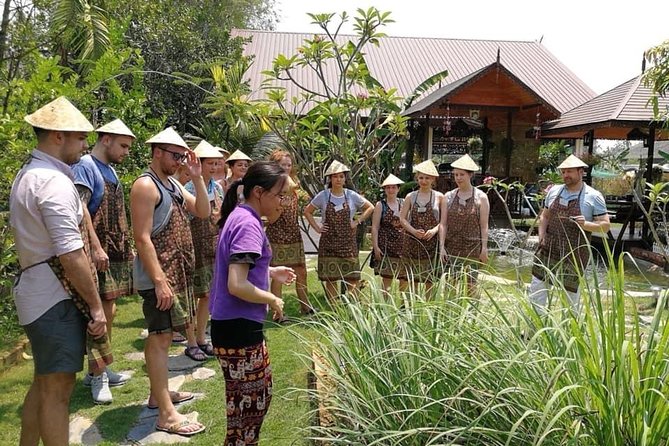
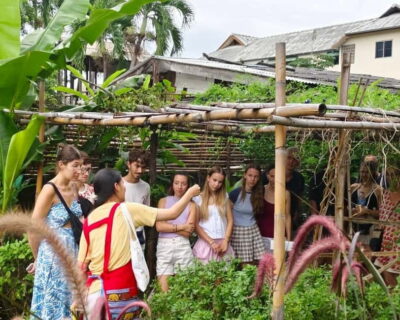
You walk through the organic garden with the instructors and learn to recognize some of the leaves and herbs in their growing form. You may pick ingredients needed for the dishes you will prepare. That small act makes the food feel more connected to its source, especially if you are used to seeing Thai herbs only in a supermarket or already chopped in a bowl.
The garden is also a welcome pause after the market and drive. The school offers a Chiang Mai-style dining room with air conditioning, plus an open-air Thai pavilion beside the garden. You can cool off, drink water, and use the bathroom before cooking begins.
The setting is not a polished cooking studio in the European sense. It is closer to a large home with a garden and cooking school attached. I see that as part of the appeal, since it gives the class a more local feel, but anyone expecting a sleek professional kitchen should set expectations accordingly.
Choose six dishes from the menu
The school contacts you about menu choices, and you select one dish from each of six categories:
- One appetizer
- One curry paste
- One curry
- One stir-fried dish
- One soup
- One dessert
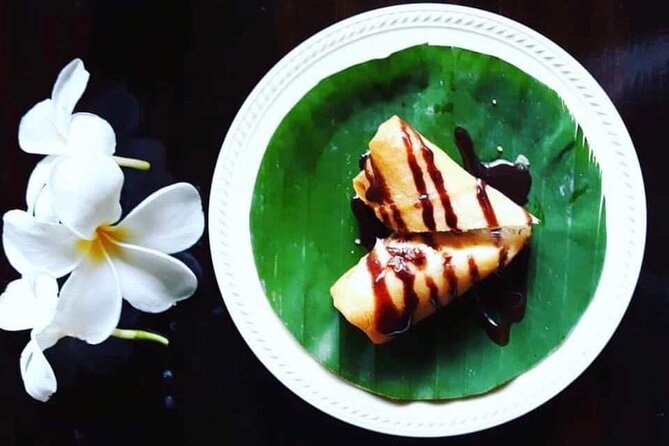
The available dishes can include familiar Thai favorites such as Pad Thai, Tom Yum soup, Khao Soi, spring rolls, fried bananas, and mango sticky rice. The exact menu choices can vary, so you should make your selections carefully on the day and tell the staff about dietary needs at that point.
This menu system is one of the strongest features of the class. Instead of cooking the same fixed meal as everyone else, you can choose dishes you genuinely want to learn. It also works well for repeat visitors to Thailand, since you can avoid making the same dishes you already know.
The six-course format offers a lot of food. The class descriptions sometimes refer to five dishes, while the detailed menu structure lists six categories. The clearest expectation is six selected menu items, including dessert, and the price covers the ingredients for all of them.
You can request mild or spicy food. Vegetarian, vegan, gluten-free, meat, and allergy options are available, but you need to tell the staff during menu selection. If you have a serious allergy, communicate it before booking and again at the class so the kitchen can confirm what it can accommodate.
One wok and one mortar for every participant
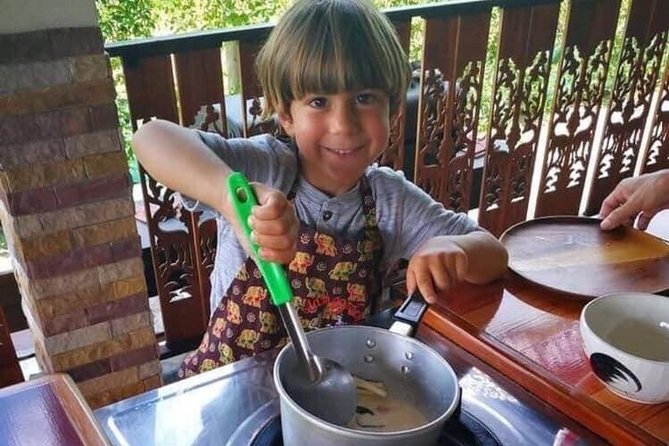
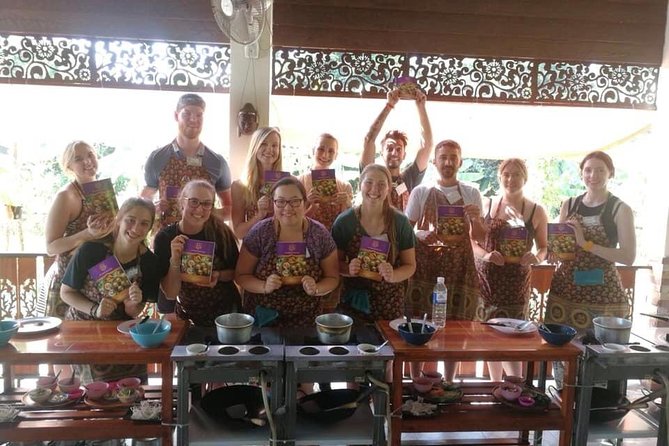
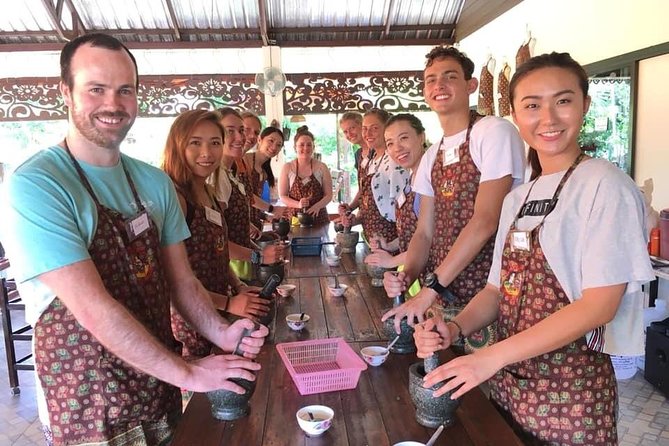
The class is hands-on rather than a simple cooking show. Each person receives an individual wok, preparation tools, cutlery, and an apron. You also make your own curry paste with your own mortar.
That setup matters. In some cooking classes, participants watch an instructor prepare the key dishes, then help with one small task. Here, you cook the food you will eat, under instruction. You learn how ingredients are combined, how dishes move from preparation to cooking, and how to adjust the spice level to suit your taste.
The instructors first give group instructions, then help individuals as needed. This is useful for beginners, since Thai cooking can involve unfamiliar ingredients and quick cooking times. The instructors have been praised for being patient, clear, and good at keeping the class moving.
The class is carefully organized. Ingredients are arranged in advance for each person, which avoids long waits and helps the group progress through the menu together. The tradeoff is that some chopping and preparation may already be done. If you want to do every step from whole ingredients, you may find the class somewhat streamlined.
One practical note: the class can feel different depending on the number of people booked. The stated maximum is 15, but one class account described a much larger group. Other sessions have had only six people. A small class gives you more direct time with the instructors, while a larger group can feel more social but less personal.
More Garden Tours in Thailand:
- Pattaya: Nong Nooch Tropical Garden Ticket for Foreigners
★ 4.5 · 417 reviews - Half day Thai cooking Class + Market tour+Garden tour
★ 5.0 · 237 reviews - Krabi: Authentic Thai Cooking Class+Thai Herbs Garden Tour
★ 4.8 · 237 reviews - Cooking Evening Class Chiang Mai Visit Organic Garden and Market
★ 5.0 · 187 reviews
Lunch in the garden or air-conditioned dining room
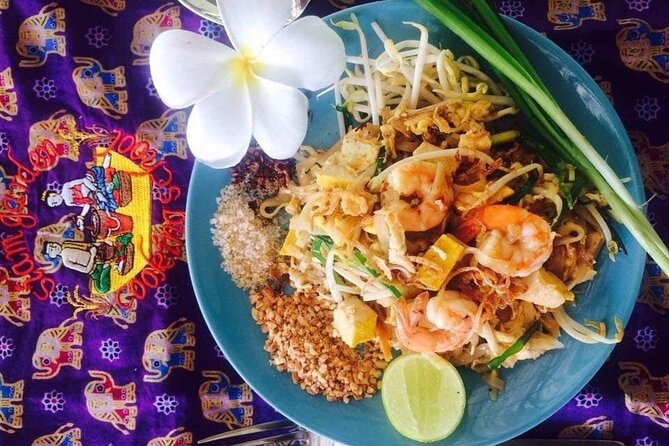
As each dish is finished, you sit down to eat what you have made. You can choose the air-conditioned dining room or the open-air Thai pavilion by the garden. Tea, coffee, and drinking water are included.
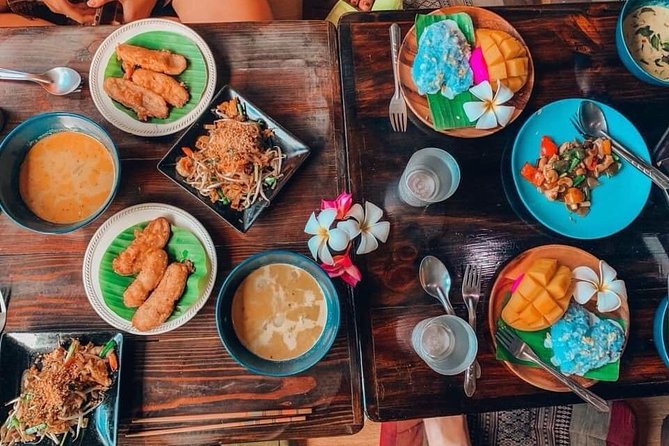
The meal is generous. With six dishes, you may produce more food than you can eat in one sitting. Leftovers can be taken away, which is useful if you want to save a dish for later rather than rush through a large lunch.
The food is the reward for the morning’s work, but it is also a useful test of the recipes. You can see how the balance of herbs, curry paste, chili, lime, and other ingredients changes from dish to dish. The ability to make food mild or hot lets you focus on flavor instead of enduring a spice level chosen by someone else.
I would not book this expecting a detailed course in Thai culinary theory. One participant put the limitation plainly: you will enjoy cooking and eating, but you will not master all of Thai cuisine in one morning. That is fair. This is a practical introduction, not a professional chef program.
Gift, Cream, and a friendly teaching team
Gift and Cream are two instructors specifically praised for their warm, helpful approach. Other staff members may also lead parts of the class, and the overall team handles the market, garden, cooking stations, food service, and photographs.
The teaching style appears lively and direct. Most of the time, the instructors are described as funny, patient, and easy to follow. One account found the lead instructor stern and loud, though the same person still considered the class enjoyable. If you prefer very quiet instruction, the group energy may take a little getting used to.
For most people, the direct style is useful. A cooking class with several woks and multiple dishes needs firm instructions, especially when everyone must move to the next step at the same time. The staff’s organization is one reason the class can handle different menus without slowing down the morning.
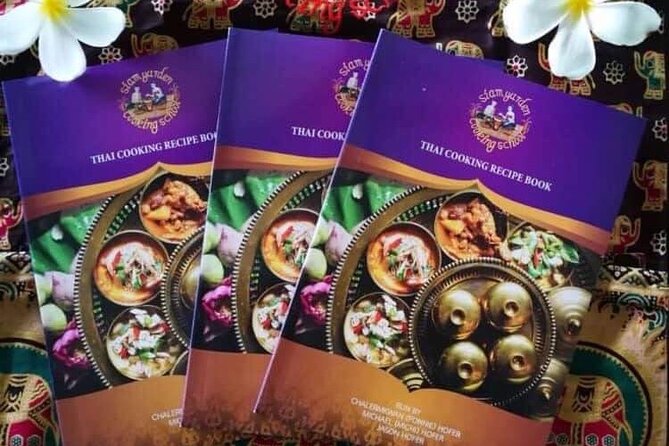
Online photo albums are included, and pictures are taken during the class. You also receive a full-color online recipe book after the experience. This is an important part of the value, since the class is not only about eating lunch in Chiang Mai. You can try to recreate the dishes at home.
What the $13.04 price really covers
At $13.04 per person, this is unusually inexpensive for a half-day experience that includes transport and a full meal. The price covers the market and garden visits, fresh ingredients, instruction, cooking equipment, tea, coffee, water, Wi-Fi, lunch, and the recipe book.
You also get hotel transport from select Chiang Mai Old Town hotels. That saves you the cost and effort of arranging a ride to the meeting point. The school is outside the center, so the pickup is more than a small convenience.
Alcohol is not included, though it can be purchased. Anyone who joins without cooking must pay a separate visitor fee, and non-participating infants or children under six are not included in the standard service. This is best priced as a cooking activity for each paying participant, not as a sightseeing tour where extra family members can tag along for free.
The value is strongest if you plan to eat a full lunch, want to cook several dishes, and will use the recipes afterward. It is less compelling if you only want to watch a chef or have a short food tasting.
Timing, transport, and practical limits
The advertised morning course runs from 9:00 a.m. to about 2:00 p.m., with around four and a half hours of activity. The exact finish can be earlier or later depending on the group.
Pickup normally takes place between 9:00 and 9:30 a.m., followed by the market around 10:00, arrival at the school at about 10:30, cooking and lunch, then the return to the meeting point. Wear comfortable clothes that can handle cooking and garden time, and bring an appetite.
Mobile tickets are accepted, and confirmation is provided when you book. The activity requires a minimum number of participants and suitable weather. If the operator cancels for either reason, you can choose another date or request a full refund.
You can cancel for a full refund up to 24 hours before the start time. Changes or cancellations inside that 24-hour window are not refunded. Since the morning depends on outdoor market and garden visits, keep an eye on the local forecast.
Who should book this Chiang Mai class?
I would recommend it to first-time visitors who want to understand common Thai ingredients through direct use. It is also a good choice for families, couples, solo cooks, and anyone who wants to make several dishes rather than one signature recipe.
Vegetarians, vegans, and people avoiding gluten have useful menu flexibility. The key is to communicate your needs during menu selection. The individual wok arrangement also suits people who like to control their own food instead of sharing one cooking station.
This class may not suit you if you dislike group activities, want a very small class guaranteed, or hope to spend most of the morning doing detailed knife work. The ingredients are partly prepared, and the class can be busy when many people book.
Should you book it?
At $13.04, this is an easy recommendation for anyone who wants a practical Thai cooking morning with transport, a market visit, a garden walk, six dishes, and a recipe book. The best features are the flexible menu, individual wok, adjustable spice level, and the chance to use herbs picked from the school garden.
Book it if you value hands-on cooking and a substantial lunch. Consider another option if you want a quiet, highly personal lesson or a small class guaranteed. If you do book, state your dietary needs early, choose dishes you have not made before, and allow extra time around the 2:00 p.m. finish.
FAQ
How long does the Chiang Mai cooking class last?
The morning course lasts about four and a half hours, usually from around 9:00 a.m. to 2:00 p.m. The finish can be earlier or later depending on the group.
Does the experience include hotel pickup?
Yes. Pickup and return transport are included from select hotels in Chiang Mai Old Town. The stated meeting point for the activity is The Pizza Company at Ruamchok Mall.
How many dishes will I cook?
You can choose one dish from each of six categories: appetizer, curry paste, curry, stir-fried dish, soup, and dessert.
Can I choose what I cook?
Yes. The class offers a selectable menu, so you can choose the dishes you prefer from the available options.
Are vegetarian, vegan, and gluten-free menus available?
Yes. Vegetarian, vegan, gluten-free, meat, and allergy options are available. Tell the staff about your needs during menu selection, and contact the school before booking if you have questions.
Can I choose the spice level?
Yes. You can ask for your food to be mild or spicy according to your preference.
Is lunch included?
Yes. You eat the food you prepare, with tea, coffee, and drinking water included. You can eat the food at the school or take it away.
What is the cancellation policy?
You can cancel up to 24 hours before the start time for a full refund. Cancellations or changes made less than 24 hours before the experience are not refunded.
Just added around Thailand
- From Chiang Mai: Temples, Sticky Waterfall, and Orchid Farm★ 4.8 · 52 reviews
- Chiang Mai: Doi Suthep, Orchid Farm and Waterfall with Lunch★ 4.7 · 4 reviews
- Bangkok: Nong Nooch Garden★ 5.0 · 3 reviews
- Bangkok:4Hour Flower Market and Little India Tour Mini Group★ 4.3 · 14 reviews
- Bangkok Floating Market & Boat Ride to an Orchid Farm★ 4.6 · 34 reviews
- Bangkok Wat Pho and Flower Market Historical Walking Tour★ 5.0 · 28 reviews
- Flower Market & Floral Art: Multilingual Private Tour [EN/others]★ 4.5 · 33 reviews
- Cooking Evening Class Chiang Mai Visit Organic Garden and Market★ 5.0 · 187 reviews
Chiang Mai Garden Tours, compared.
Cooking Class, Market & Thai Herbs Garden Tour
Read our review →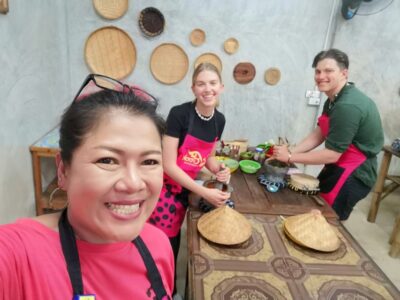
Cooking Evening Class Chiang Mai Visit Organic Garden and Market
Read our review →
Browse the lists this tour appears in