Review · TOURS
Secret Gardens and Squares Downtown | Walking Tour of Budapest
Budapest’s best surprises may be behind its worst-looking doors. This 2.5-hour walk takes you past battered facades and into private courtyards where old trees, flowers, and quiet garden spaces sit inside the city’s apartment blocks. I like the access, since these places are normally closed to the public, and I like the mix of house design, plant life, and true stories about former residents. The small group limit of 20 should also help keep the walk personal.
The main caution is expectation. The promise of secret gardens sounds grand, but the actual route may feel more like a thoughtful architectural and history walk with garden stops than a tour of large, formal parks. One person found the guide very well informed but felt the experience did not fully match the description, so book it for unusual access and stories, not a parade of major sights.
Key points to know before you book
- Private courtyards: You can enter beautiful inner spaces that are otherwise closed to the public.
- A different Budapest: The focus is on apartment-house courtyards, gardens, old trees, flowers, and overlooked city corners.
- Stories with a human edge: Expect tales of love, death, glory, defeat, former residents, and the growth of Budapest.
- Architecture and plants together: You learn how buildings were made and hear about botanical curiosities along the route.
- Two and a half hours on foot: The tour starts at 10:00 am in Kamermayer Károly tér and finishes at Kálvin tér.
- Small-group format: The maximum group size is 20, with an English-speaking local guide and light refreshments included.
Why Budapest’s plainest doors matter
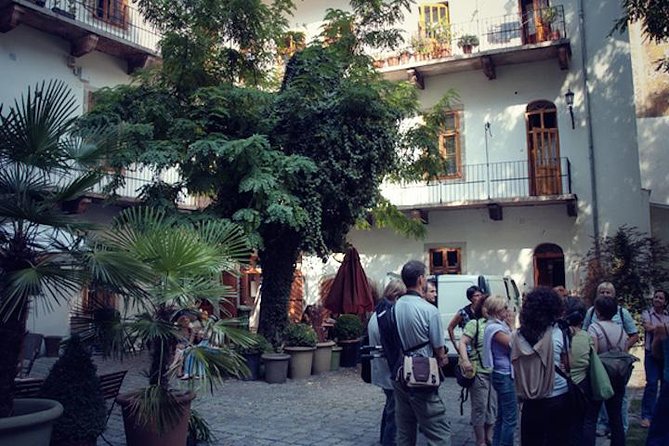
At street level, Budapest can give you very little to work with: a worn facade, an anonymous gateway, and a large double door. The appeal of this walk is the turn inward. Once you pass through those entrances, the city changes from traffic and shopfronts to courtyards, trees, flowers, and old residential buildings.
I like tours that show how a city works rather than simply pointing at its most famous monuments. Budapest’s inner courtyards reveal a side of daily life that you can easily miss if you stay on the main avenues. These spaces were tied to the people who lived around them, and their stories give the walk a more personal scale.
The tour also connects nature with architecture. You are not only looking at flowers or old trees as decoration. You hear about the way Budapest developed, how its houses were built, and the plant curiosities found in these enclosed spaces. That combination gives you more to notice during the rest of your time in town.
Do keep the word secret in perspective. This is not a fantasy garden tour, and no exact number of courtyards or gardens is provided. The experience is best suited to you if you enjoy access, atmosphere, and city history more than a fixed checklist of famous sights.
More Garden Tours in the world:
- Paris: Versailles Palace and Gardens Full Access Ticket
★ 4.6 · 41,579 reviews - Amsterdam: Keukenhof Entry & Shuttlebus with Flexible Return
★ 4.7 · 11,891 reviews - Versailles: Skip-the-Line Tour of Palace and Gardens Access
★ 4.7 · 10,429 reviews
Starting at Kamermayer Károly tér at 10:00
The meeting point is Kamermayer Károly tér, in central Budapest, with the walk beginning at 10:00 am. The location is near public transportation, which makes it practical to reach from other parts of the city.
A morning start works well for this kind of outing. You get the walk done before the middle of the day, leaving your afternoon open for museums, the river, or another neighborhood. It also gives you an early introduction to central Budapest before you explore on your own.
The tour ends at Kálvin tér. That matters because this is a point-to-point walk rather than a return to the starting location. You should plan your day around finishing there, not around being taken back to your hotel. Transportation to and from the attractions is not included, so you handle your own journey to the meeting point and away from the endpoint.
The full walk lasts about two and a half hours. That is long enough to develop a theme without taking over your whole day, but you should still wear comfortable shoes and be ready to remain on foot for the duration. A moderate level of physical fitness is recommended.
Passing through the first unmarked gateway
The opening image of the tour is its strongest selling point: from the street, you may see only a battered exterior and a heavy doorway. The guide then shows you what sits behind it. That contrast between public frontage and private interior is the central idea of the walk.
These courtyards are not presented as isolated curiosities. They help explain the character of Budapest’s apartment houses. The buildings hold shared inner spaces, and those spaces can be surprisingly calm compared with the streets outside. You get a sense of how residents once moved through their homes and communal areas.
The architectural side is important here. One five-star assessment specifically praised seeing courtyards that were not normally open and learning how the houses were built. That is a useful clue about the tour’s real appeal. You are not simply being led through pretty corners. You are asked to look at construction, layout, and the relationship between the street facade and the inner court.
Exact buildings and stops are not listed in advance. That is part of the mystery, but it also means you cannot judge the tour by a promised set of named landmarks. The value lies in the access and explanation rather than in collecting a known list of addresses.
Gardens inside apartment blocks
The gardens are the heart of the outing. Old trees, flowers, and inner green spaces appear among apartment houses, creating small pockets of rest and quiet. In a city walk, these changes of mood are welcome. You get a break from streets and monuments without leaving central Budapest.
I would not treat this as a botanical garden visit in the formal sense. The available details point to a series of private courtyards and garden areas, not one large public collection. The plant material matters because the guide discusses botanical curiosities, but the gardens also matter as part of the buildings and their past.
That makes the experience especially suitable for people who have already seen Budapest’s main sights or who want something less standard from the beginning. You may find the gardens modest rather than grand, yet their setting is what makes them interesting. A flower or tree becomes more memorable when it appears behind a door that most people pass without a second look.
The private access is a real benefit. You cannot assume you could visit these spaces independently, and the tour gives you a legitimate way to see them. The tradeoff is that access can depend on the places available on the day, so you should not expect every stop to be identical to a promotional image or a previous visit.
Same corner of the map, a different planting:
- Marrakesh: Majorelle Garden Entry Tickets
★ 4.5 · 9,651 reviews - Vienna: Schönbrunn Palace & Gardens Skip-the-Line Tour
★ 4.7 · 7,739 reviews - Granada: Alhambra & Gardens Tour w/Nasrid Palaces Option
★ 4.2 · 7,022 reviews - From Paris: Versailles Palace & Gardens with Transportation
★ 4.6 · 6,222 reviews
Stories of love, death, glory, and defeat
The guide uses the courtyards as settings for stories about people and events connected with the old town. The themes are broad but human: love, death, success, failure, and the lives of people who once occupied these buildings.
That storytelling helps prevent the walk from becoming a string of architectural facts. You are not only told when a building was made or how it was arranged. You are encouraged to picture the people who lived there and the events that gave these places meaning.
One five-star account described the stories as feeling close to the present, even though they came from the past. That is the kind of guiding this tour aims for: linking a quiet courtyard to a tale that makes the place feel inhabited rather than merely old.
The guide’s role matters a great deal. The walk is offered in English, and the quality of the explanation will shape the whole experience. The strongest feedback praised an engaging, informed guide who reached places ordinary sightseeing does not cover. Another account found the guide well informed but felt some of the tour did not live up to the description. In practical terms, you should book this if you enjoy guided interpretation and accept that the atmosphere may be stronger than the spectacle.
Learning how Budapest grew
The tour also gives you a short lesson in the development of Budapest. The focus is not only on individual buildings but on how the city changed and how residential spaces fit into that growth.
This broader context gives the courtyards a reason to matter. Without explanation, an inner garden is simply a pleasant place to stand. With the right details, it becomes evidence of how the city housed people, organized shared space, and adapted over time.
The architecture lesson may be one of the most useful parts for you. If you have ever walked through Budapest and wondered what lies behind its heavy doors, this tour answers that question directly. You learn to read the city from the outside, then compare that public face with what lies inside.
Because the route is in the heart of Budapest, it works well as a supplement to more familiar sightseeing. It does not replace a major museum or landmark visit. Instead, it gives you a way to understand the ordinary residential fabric around those headline attractions.
Light refreshments and a group of up to 20
Light refreshments are included, along with local taxes and the local guide. This is a small benefit rather than the reason to book, but it is useful during a 2.5-hour morning walk. You do not need to treat the refreshments as a meal, so have breakfast before you arrive.
The group can include up to 20 people. That is not an intimate private tour, but it is still manageable for a walking experience if the guide handles the group well. A smaller group should also make it easier to enter courtyards and hear the explanations than a large coach group would.
The mobile ticket keeps the booking simple. Confirmation is sent within 48 hours, subject to availability. Service animals are allowed, and the meeting point is near public transportation. Those details make the outing straightforward, though the moderate fitness requirement remains important because this is a walking tour rather than a seated visit.
Is $47.66 a fair price?
At $47.66 per person, this is not the cheapest way to spend a morning in Budapest. You can walk many central streets for free, and public courtyards that are open to everyone cost nothing. The price needs to be judged by what you cannot easily arrange alone.
The strongest value comes from access to private gardens and courtyards, plus the guide’s interpretation. If you simply want to see attractive outdoor spaces, the price may feel high. If you care about entering places normally closed to the public and understanding how the houses were built, the cost makes more sense.
The included refreshments add a little convenience, but they do not change the calculation. You are paying mainly for the route, access, stories, and local guidance. Since the maximum group is 20 and the walk takes about two and a half hours, the price is most worthwhile when the guide brings the places to life.
I would compare it with your personal interests. Architecture fans, garden lovers, repeat visitors, and people who prefer small-scale city stories are likely to get more from it than first-time visitors trying to cover every major Budapest sight. If your time is short and you want only famous landmarks, choose a different kind of tour.
What to know before you set out
A few practical points can help you enjoy the experience:
- Arrive ready for a 10:00 am start at Kamermayer Károly tér.
- Wear comfortable shoes and expect to walk for about two and a half hours.
- Plan your onward journey from Kálvin tér, since transportation is not included.
- Keep expectations flexible because the exact gardens and courtyards are not specified.
- Treat the walk as a mix of architecture, plants, and stories, not as a formal garden visit.
- Book at least 24 hours before the start if you want the option of a full refund.
The cancellation rule is simple: you can cancel for a full refund up to 24 hours before the start time. Cancellations or changes made less than 24 hours before the experience are not refunded or accepted, and the cut-off uses Budapest local time.
Who should book this Budapest walk?
I would choose this tour if you like the parts of a city that most people hurry past. It suits you if a plain doorway makes you curious, if you enjoy hearing how buildings were made, or if you want stories tied to real places rather than a standard list of monuments.
It is also a good choice for a second or third day in Budapest, when you have already seen some of the main sights and want a quieter look at the city. Garden lovers should enjoy the old trees and flowers, though anyone expecting a grand botanical display should adjust their expectations.
I would hesitate if your walking ability is limited, if you need a fully fixed route, or if you want a tour centered on major attractions. The mixed feedback also suggests keeping your expectations measured. The experience can be original and memorable, but its success depends heavily on the guide, the available private spaces, and how closely the actual route matches your idea of a secret garden tour.
For $47.66, book it for access and perspective. You will see Budapest from behind its doors, learn how its residential courtyards work, and hear old stories in places that are easy to miss. That is a fair trade for a morning if those small discoveries matter more to you than grand views.
FAQ
Where does the tour start?
The tour starts at Kamermayer Károly tér, 1052 Budapest, Hungary.
Where does the tour end?
The tour ends at Kálvin tér in Budapest.
What time does the tour begin?
The start time is 10:00 am.
How long does the tour last?
The walk lasts approximately 2 hours and 30 minutes.
Is the tour offered in English?
Yes. The tour is offered in English.
Are refreshments included?
Yes. Light refreshments are included in the tour price.
How many people can join the tour?
The tour has a maximum group size of 20 people.
Can I cancel for a full refund?
Yes. You can cancel for a full refund if you cancel at least 24 hours before the experience starts.
Just added around the world
- Yu Garden Shanghai Entry Tickets Booking And Trip★ 3.6 · 9 reviews
- Zanzibar: Jozani Monkeys, Butterfly Garden & Reptile Park★ 5.0 · 2 reviews
- York: Castle Howard Gardens and Grounds Entry Ticket★ 4.5 · 23 reviews
- York: Castle Howard House and Gardens – Self-Guided★ 4.8 · 120 reviews
- Royal Horticultural Society: Harlow Carr Garden Ticket★ 4.7 · 14 reviews
- Woking: Royal Horticultural Society Wisley Garden Ticket★ 4.7 · 24 reviews
- Woodside: Filoli Historic House and Garden Entry Ticket★ 4.9 · 9 reviews
- Xochimilco floating gardens, Coyoacan and UNAM murals★ 4.0 · 6 reviews
Tours, compared.

Skip-the-Line Tour of Palace and Gardens Access
Read our review →
Schönbrunn Palace & Gardens Skip-the-Line Tour
Read our review →
Alhambra & Gardens Tour w/Nasrid Palaces Option
Read our review →
Skip-the-Line Schönbrunn Palace & Gardens Tour
Read our review →
Cooking Class, Market & Thai Herbs Garden Tour
Read our review →
Versailles Palace Guided Tour & Gardens Access
Read our review →
Versailles Palace and Gardens Tour from Paris
Read our review →