

Review · AUSTRIA GARDEN TOURS
Salzburg: Old Town, Mozart, & Mirabell Gardens Walking Tour
Salzburg packs an astonishing amount into a compact old center, and this two-hour walk gives you the quick, colorful introduction you need. You move from Mirabell Palace and its Do-Re-Mi garden setting across the Salzach River to Mozart’s birthplace, grand churches, broad squares, and the foot of Hohensalzburg Fortress.
I like the mix of Mozart’s real story and Sound of Music locations, rather than treating Salzburg as only a movie set. I also like the practical advice built into the walk, including what to see after the tour and which sights deserve your time. The main drawback is the pace: two hours is efficient, but some visitors found the guide moved quickly or was difficult to hear in crowded places.
Key points to know before booking
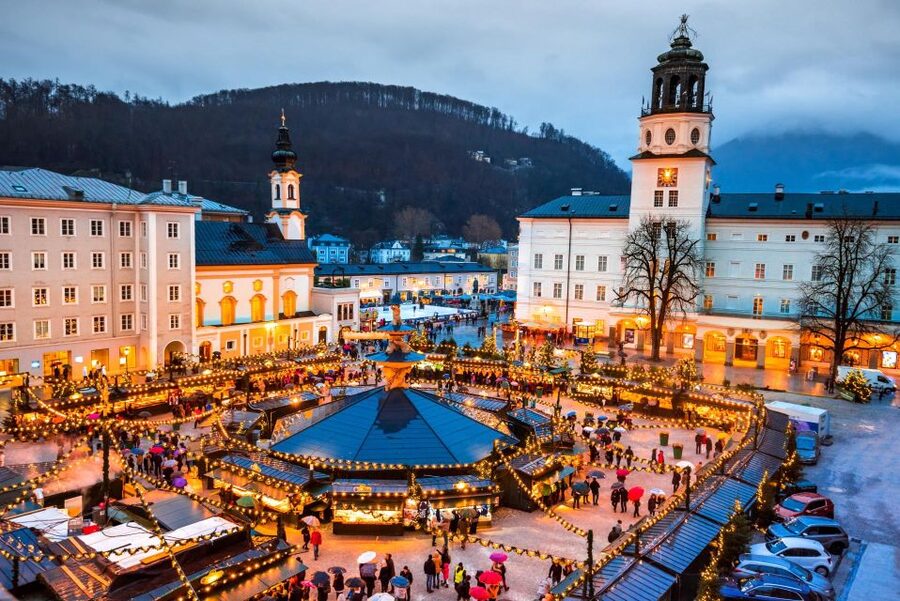
- Mirabell Gardens opens the tour with movie locations: You see the setting for the famous Do-Re-Mi scenes and hear how the location fits into Salzburg’s story.
- Mozart gets more than a name check: The route includes his birthplace on Getreidegasse and other places linked with his family and career.
- The route covers Salzburg’s main postcard sights: Expect Mirabell, Kollegienkirche, Salzburg Cathedral, Residenzplatz, Alter Markt, and Kapitelplatz.
- Guides add personality: Annabelle, Andreas, Florian, Elisabeth, Erhard, and others have been praised for humor, clear explanations, local tips, and strong storytelling.
- The tour ends well for further sightseeing: Kapitelplatz puts you near the funicular for Hohensalzburg Fortress and within easy reach of several central sights.
- It is a proper city walk: Wear comfortable shoes, leave luggage behind, and be ready for sun, rain, uneven paving, and crowds.
Starting beside Mirabell Palace

The advertised starting location is Rainerstraße 1, with detailed meeting instructions directing you to the main entrance of Salzburg Congress at Rainerstraße 3. Look for the flagpoles between the Congress building and Kurgarten Park, opposite the HYPERION Hotel. The directions also identify the spot near the turn from Auerspergstraße 6.
This is one place where you should pay attention rather than casually wander up at the last minute. Arrive 10 minutes early. Latecomers cannot join the group or receive a refund, and there is no storage for luggage, scooters, umbrellas, extra clothing, or baby carriages.
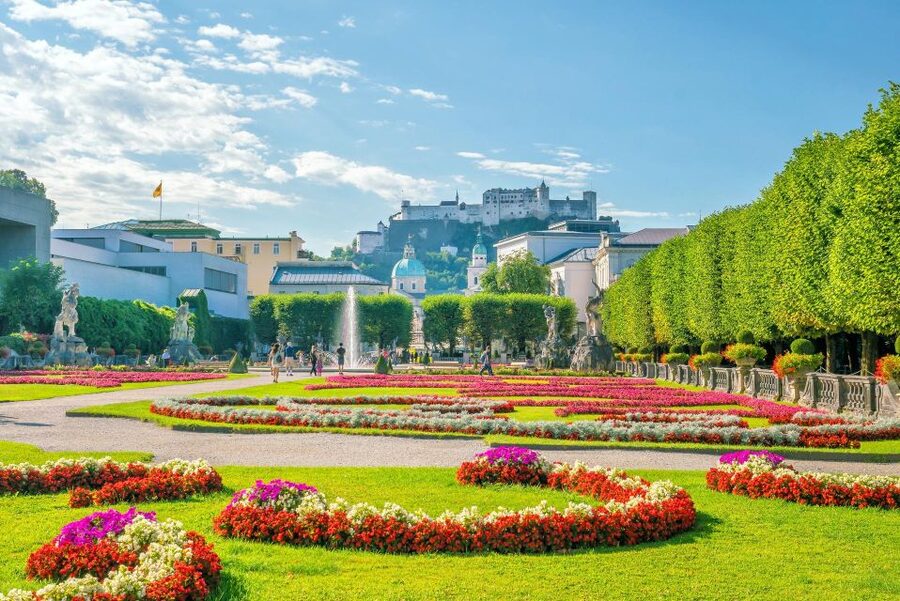
From the meeting point, the walk begins around Mirabell Palace. You get a photo stop at the palace before spending about 30 minutes in the gardens. That opening works well because you begin with one of Salzburg’s most polished views: formal gardens, palace architecture, and the fortress rising in the distance.
More Garden Tours in Austria:
- Vienna: Schönbrunn Palace & Gardens Skip-the-Line Tour
★ 4.7 · 7,739 reviews - Vienna: Skip-the-Line Sisi Museum, Hofburg and Gardens Tour
★ 4.8 · 5,918 reviews - Vienna: Skip-the-Line Schönbrunn Palace & Gardens Tour
★ 4.8 · 5,411 reviews
Mirabell Gardens and the Sound of Music connection
Mirabell Gardens is not just a pretty first stop. It is one of the places where Salzburg’s pop-culture fame becomes easy to understand. The garden’s paths, statues, steps, and orderly flower beds provided the setting for the Do-Re-Mi scenes in The Sound of Music.
Your guide points out the visual cues that connect the real place with the film. That is useful if you know the movie well, but the stop still works if you have never seen it. The palace and garden provide a calm contrast to the tighter streets of the Old Town, and the open setting gives you a chance to take photographs before the walking becomes more concentrated.
The gardens are free to enter as part of the tour. Seasonal conditions matter, though. Some sections are partly closed in winter, and from November 21 through January 5 the route may include a local Christmas market instead. In extreme weather, such as heavy snow, the operator may use an alternative route for safety.
The garden can also be hot and exposed in summer. One visitor enjoyed the guide but found the sun uncomfortable, so bring weather-appropriate clothing and water for the walk. In wet conditions, the tour continues, so a rain jacket and sensible shoes are more useful than an umbrella you cannot store.
Crossing the Salzach into Mozart’s Salzburg

The group then crosses the Salzach River toward the Old Town. This is a short transition, but it gives you a useful sense of Salzburg’s layout. Mirabell sits on one side of the river, while the historic center, cathedral, palace squares, and fortress gather on the other.
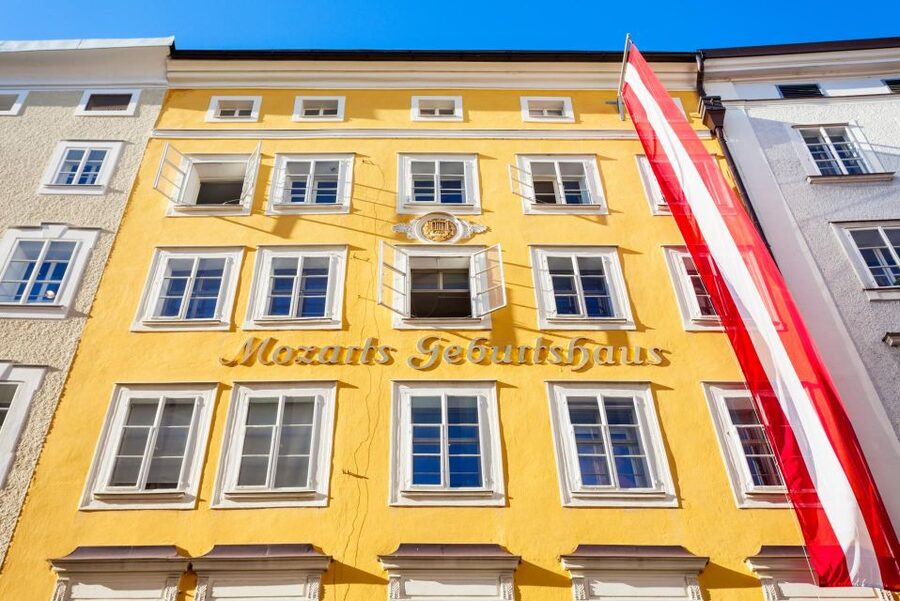
The Mozart section begins along Getreidegasse, Salzburg’s famous shopping street. Its painted signs, narrow frontage, and tightly packed buildings make it one of the city’s most memorable streets, even when it is crowded. The tour stops outside Mozart’s Birthplace, where Wolfgang Amadeus Mozart was born and where his early connection with Salzburg becomes part of the story.
The tour does not include entry to the Mozart museum. That is worth knowing before you book. You see the exterior and receive the guide’s explanation, but you would need a separate visit if you want the indoor exhibits.
The route also refers to Mozart’s former residence and other family connections. A music teacher on one tour especially appreciated the attention to Mozart’s homes, his sister, and later family connections. If you want a full Mozart museum visit, allow extra time after the walk rather than expecting this two-hour experience to cover every interior.
Kollegienkirche and Salzburg’s Baroque churches
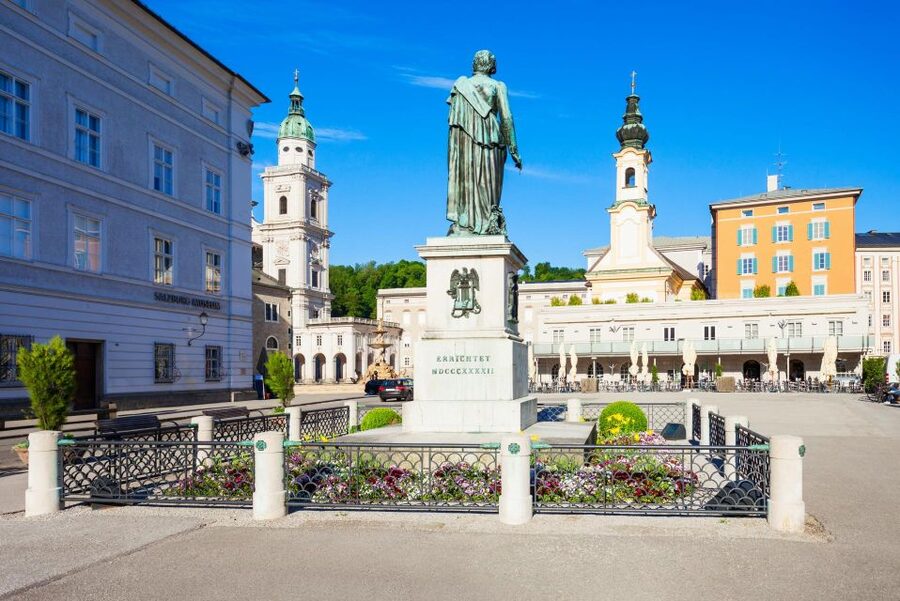
The walk continues to the University Church, or Kollegienkirche, with about 20 minutes for sightseeing. Its scale and bright Baroque design show why Salzburg can feel almost theatrical even on an ordinary street.
This part of the tour is particularly useful because a guide can explain what you are looking at rather than leaving you to admire a grand facade without context. You may hear about the city’s archbishops, their spending, church power, and the way religion shaped Salzburg’s buildings and public spaces.
The churches are not just decorative stops. They help explain why the city center has such an unusual concentration of monumental architecture. The guide’s job here is to connect the buildings to the people and institutions behind them. Several guides have been praised for handling serious subjects, including the excesses of archiepiscopal rule and the realities of World War II, without turning the walk into a dry lecture.
The tradeoff is that the tour moves through several major sights in a short time. If you want to sit quietly inside each church, study every ceiling, or attend a service, you will need to return on your own.
Same corner of the map, a different planting:
- Vienna: Skip the Line Schönbrunn Palace and Gardens Guided Tour
★ 4.5 · 1,540 reviews - Vienna: Schönbrunn Palace & Garden Skip-the-Line Guided Tour
★ 4.1 · 1,240 reviews - Vienna: Skip-the-Line Schönbrunn Palace and Gardens Tour
★ 4.8 · 1,089 reviews - Vienna: Skip-the-Line Schönbrunn Palace & Gardens Tour
★ 4.5 · 845 reviews
Salzburg Cathedral and the big central squares
Salzburg Cathedral receives another 20-minute sightseeing stop. This is the architectural heart of the route, and its broad facade and great dome make a strong impression after the narrower lanes of Getreidegasse.
The guide gives you a framework for understanding the cathedral and the city around it. That matters in Salzburg, where major buildings often sit only a few minutes apart but represent different periods and uses. You get enough explanation to recognize the cathedral as more than a photogenic church, while still having time to look around.
Next comes Residenzplatz, one of Salzburg’s grandest open spaces. The square helps you read the city as a former seat of powerful archbishops, with the cathedral, palace, and surrounding historic buildings forming a formal urban stage.
The route also includes Alter Markt, a smaller and more intimate square. This is one of the useful contrasts of the walk. Salzburg is not only monumental facades and famous viewpoints. There are also compact corners, old buildings, shopfronts, and details that are easy to miss if you follow only the main road.
Special events can change the feel of these squares. Musical performances, festivals, and local events may bring large crowds, make it harder to hear, or slightly alter the route. The guide generally keeps the group together, but a busy day requires patience.
Kapitelplatz and the view toward Hohensalzburg Fortress

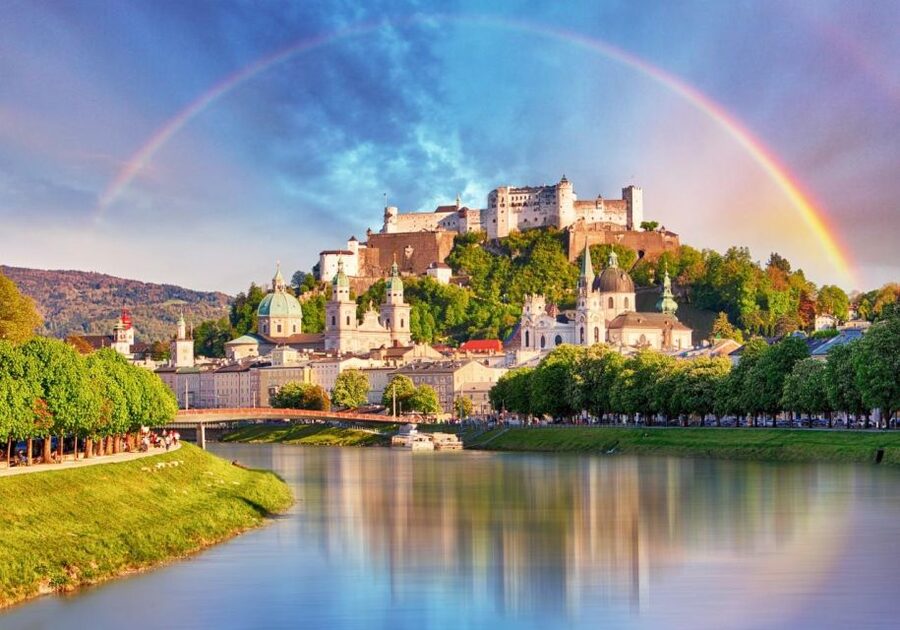
The official finish is Kapitelplatz, a smart place to end a first look at Salzburg. Here you get a strong photo angle toward Hohensalzburg Fortress, perched above the city. The Goldene Kugel, or Sphera, also provides one of the route’s more unusual visual landmarks.
The ending is practical as well as scenic. From Kapitelplatz, you are well placed to continue toward the fortress funicular, visit more of the old center, or stop for food and a drink. One guide also suggested choices such as the fortress, the modern art museum, and the Mozart museum, helping visitors decide what to do with the rest of the day.
This is why I would schedule the tour early in a Salzburg stay if possible. You get the city’s basic map, then can return to the places that caught your attention. The walk is not designed to replace the fortress, Mozart’s museums, or a longer city visit. It helps you choose among them.
What the guides add to the walk
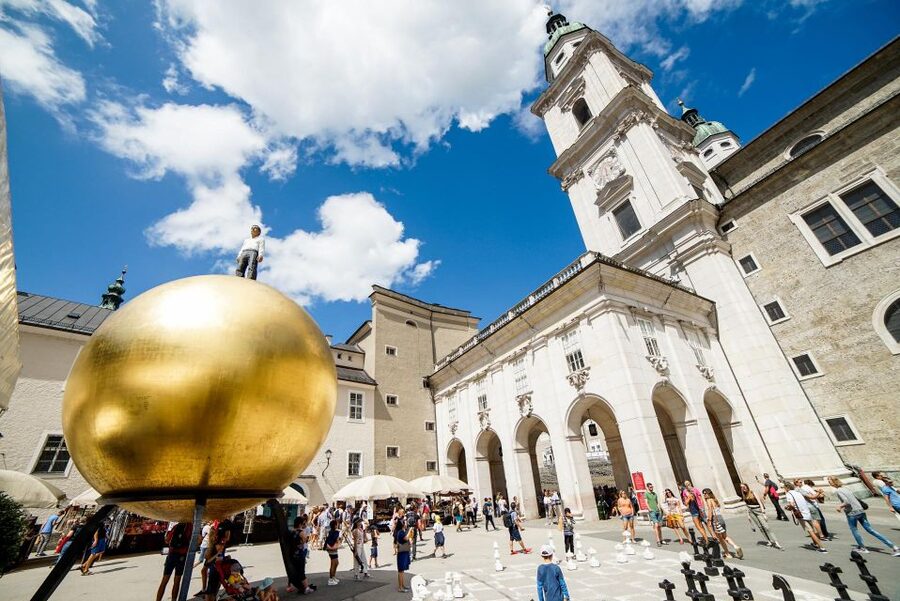
The strongest part of this experience is the guide. The named guides have varied styles, but the repeated strengths are clear: lively delivery, local recommendations, humor, and the ability to connect historical facts with familiar places.
Annabelle has been praised for keeping groups engaged, offering clear local advice, and even singing songs from The Sound of Music. Andreas is known for taking questions and asking what people want to learn more about. Florian brings humor to the route, while Elisabeth and Erhard have been appreciated for friendly, engaging explanations.
You may also find the guide using a blue umbrella to keep the group visible. That small detail helps on a busy day, especially when Salzburg’s central streets are full. One guide kept a large group together during a local sports event and made sure people could hear and stay on route.
There are limits. Group size can reach 25 people, and a guide’s voice may be harder to catch beside traffic or in a crowded square. One visitor found the guide difficult to hear at times, while another felt the pace was rushed. If you are sensitive to group walking speeds, stay near the guide and ask questions when the group pauses.
The tour is offered in English, with live commentary in only one selected language. That keeps the presentation focused, but it also means you should book the English option only if you are comfortable following spoken English for two hours.
Is $45 a fair price for two hours?
At $45 per person, this is not the cheapest way to walk around Salzburg, since the public streets and Mirabell Gardens are free. You are paying mainly for the guide’s time, route planning, historical context, and local advice.
For a first visit or a short stay, I think the price can be fair. You cover a large portion of the Old Town without spending time working out the route yourself, and you receive useful suggestions for the rest of your day. The guide can also point out connections between Mozart, the archbishops, The Sound of Music, and Salzburg’s wartime past that are easy to miss when you explore alone.
The value is lower if you already know the Old Town well or prefer slow, self-directed sightseeing. You should also remember that major interiors are not included. Mirabell Gardens entry is included, but the museums, cathedral interior access if separately charged, fortress, and other attractions require their own arrangements.
The free cancellation period is up to 24 hours before the tour, and you can reserve now and pay later. Those terms are useful if your Salzburg plans are still changing.
Who should book this Salzburg walk?
I would recommend it to first-time visitors, solo visitors who want an easy orientation, families with older children, and anyone with only a day or two in the city. It is also a good fit if Mozart and The Sound of Music are both on your list, since the tour gives each subject space without becoming a full museum program.
History fans will appreciate the discussion of archiepiscopal power, churches, the city’s political past, and World War II. Music lovers get the Mozart locations and musical context. Film fans receive the garden scenes and visual reminders of where The Sound of Music was filmed.
I would hesitate if you have mobility limitations. The tour is not suitable for people with mobility impairments, and the route includes uneven surfaces, standing, and steady walking. Pets, large bags, luggage, scooters, and baby carriages are not allowed.
The weather policy also matters. The walk goes ahead in sun or rain, so dress for the forecast. Winter visitors should expect partial garden closures or a different route, and those visiting between November 21 and January 5 may see a Christmas market instead of the full garden experience.
Should you book it?
Book this tour if you want a fast, well-guided introduction to Salzburg with Mozart, Mirabell, Baroque churches, film locations, and fortress views in one compact route. The best reason to choose it is the guide’s storytelling and practical advice, not admission to major attractions.
Skip it if you already know Salzburg’s center, dislike group walks, or want long indoor visits at museums and churches. For most first-time visitors, $45 is reasonable when the tour is used as an orientation: take notes, ask what to do next, and return afterward to the places that deserve more time.
FAQ
How long is the Salzburg walking tour?
The tour lasts two hours.
What language is the live tour in?
The live commentary is in English, with only one selected language used during the tour.
Where does the tour meet?
Meet at the main entrance to Salzburg Congress, opposite the HYPERION Hotel at Rainerstraße 3. Wait under the flagpoles between the Congress building and Kurgarten Park. The starting location is also given as Rainerstraße 1.
Is entry to Mirabell Gardens included?
Yes. Free entry to Mirabell Gardens is included. Some parts may be closed in winter, and extreme weather can lead to an alternative route. From November 21 through January 5, the route may include a local Christmas market.
Can I bring luggage, a pet, or a stroller?
No. Pets, luggage, large bags, scooters, extra clothing, umbrellas, and baby carriages are not allowed, and there is no storage for them.
Can people with mobility impairments join the tour?
No. The tour is not suitable for people with mobility impairments. Comfortable shoes are recommended because the route includes uneven surfaces.
Just added around Austria
- Schönbrunn Palace & Gardens Tour★ 4.2 · 42 reviews
- Schönbrunn Palace and Gardens Tour★ 5.0 · 120 reviews
- Vienna: Carriage Ride Through Schönbrunn Palace Gardens★ 4.6 · 96 reviews
- Salzburg Old Town Walking Tour, Mozart, Mirabell Gardens★ 4.5 · 201 reviews
- Skip-the-Line Sisi Museum, Hofburg and Gardens Tour Vienna★ 4.5 · 449 reviews
- Vienna: Skip-the-Line Schönbrunn Palace & Gardens Tour★ 4.5 · 845 reviews
- Vienna: Schönbrunn Palace & Garden Skip-the-Line Guided Tour★ 4.1 · 1,240 reviews
- Vienna: Skip-the-Line Schönbrunn Palace and Gardens Tour★ 4.8 · 1,089 reviews
Austria Garden Tours, compared.
Schönbrunn Palace & Gardens Skip-the-Line Tour
Read our review →
Skip-the-Line Schönbrunn Palace & Gardens Tour
Read our review →
Skip the Line Schönbrunn Palace and Gardens Guided Tour
Read our review →
Schönbrunn Palace & Garden Skip-the-Line Guided Tour
Read our review →
Skip-the-Line Schönbrunn Palace and Gardens Tour
Read our review →
Skip-the-Line Sisi Museum, Hofburg and Gardens Tour Vienna
Read our review →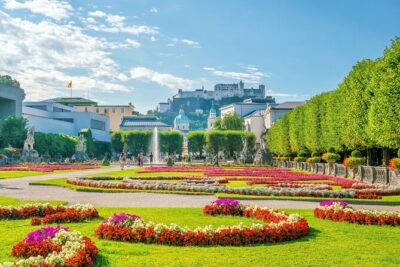
Salzburg Old Town Walking Tour, Mozart, Mirabell Gardens
Read our review →Browse the lists this tour appears in